Case 1
NIST CFReDS Hacking Case: Windows XP disk image
Examined the NIST CFReDS Windows XP image in Magnet AXIOM and Wireshark. Tool execution and a recovered packet capture are confirmed; unauthorized intrusion is not established.
Account
Confirmed
Mr. Evil is a local administrator on Greg Schardt's Windows XP laptop.
Tools
Confirmed
Hacking tools on disk; their installers were deleted to the Recycle Bin.
Remote share
Confirmed
A shortcut and Shellbags reach the \\4.12.220.254\TEMP share.
Executed
Confirmed
Prefetch: Cain ran twice and Ethereal once on 27 Aug 2004.
Captured
Confirmed
Recovered PCAP: a Hotmail POST answered with "Message sent!".
Shown in figures 10
Intrusion
Not proven
No access to a third-party host or theft of credentials is shown.
Case CASE-009: Greg Schardt Hacking Case
NIST CFReDS Windows XP disk image examination.
| Item | Value |
|---|---|
| Examiner | Turki Adnan Abbas · تركي عدنان عباس |
| Evidence | 4Dell Latitude CPi.E01 (multi-segment E01 set) |
| Primary tools | Magnet AXIOM Examine 7.8, Wireshark, PowerShell |
| Time standard | UTC (AXIOM display configured UTC+00:00) |
Executive conclusion
The examination identified a Windows XP system registered to Greg Schardt and a local administrative user profile named Mr. Evil. The system contained network discovery, traffic-capture, password-recovery, and remote-access tools. Prefetch artifacts support execution of Cain and Ethereal. A valid packet capture recovered from the Mr. Evil profile records HTTP traffic, including a Hotmail form submission for which the application returned “Message sent!”.
These combined findings support network reconnaissance and packet-capture activity. The acquired evidence does not, by itself, prove an unauthorized compromise of a third-party host, credential theft, or delivery of the captured email to its destination mailbox. The CFReDS case is a training/reference scenario; allegations in the case description are treated as hypotheses rather than established facts.
| Assessment | Determination |
|---|---|
| Use of network/security tooling | Supported by application files and Prefetch |
| Captured network communications | Confirmed by recovered PCAP |
| Hotmail submission acknowledged | Confirmed by application response |
| Successful unauthorized intrusion | Not established from examined evidence |
1. Scope and evidence handling
The examination reviewed the supplied forensic disk image through Magnet AXIOM artifacts and file-system views, examined a user-profile packet capture in Wireshark, and correlated the results with Windows Registry, Prefetch, shortcut, browser-history, and Recycle Bin artifacts. Findings are attributed to their originating artifact rather than to a person merely by naming convention.
| Item | Value |
|---|---|
| Case identifier | CASE-009 |
| Evidence identifier | 4Dell Latitude CPi.E01 |
| Primary NTFS partition | Approximately 4.53 GB |
| Operating system | Microsoft Windows XP 5.1, build 2600 |
| Recovered capture | Documents and Settings\Mr. Evil\interception |
| PCAP SHA-256 | 2e24e6ef3d71602d7c091b9c55649f900b908f1e8e648bad48283d4b98d38848 |
| SecEvent.Evt export SHA-256 | 69e8d6daf3a51780bb4adeef4190622bec003468c8206724be8c0c560f4d5484 |
Hash scope: the two SHA-256 values above apply only to the separately exported PCAP and SecEvent.Evt, respectively. A whole-image acquisition hash was not independently verified during this examination. Source screenshot timestamps are expressed as displayed by AXIOM in UTC+00:00; file-system times should not be silently treated as local Central time.
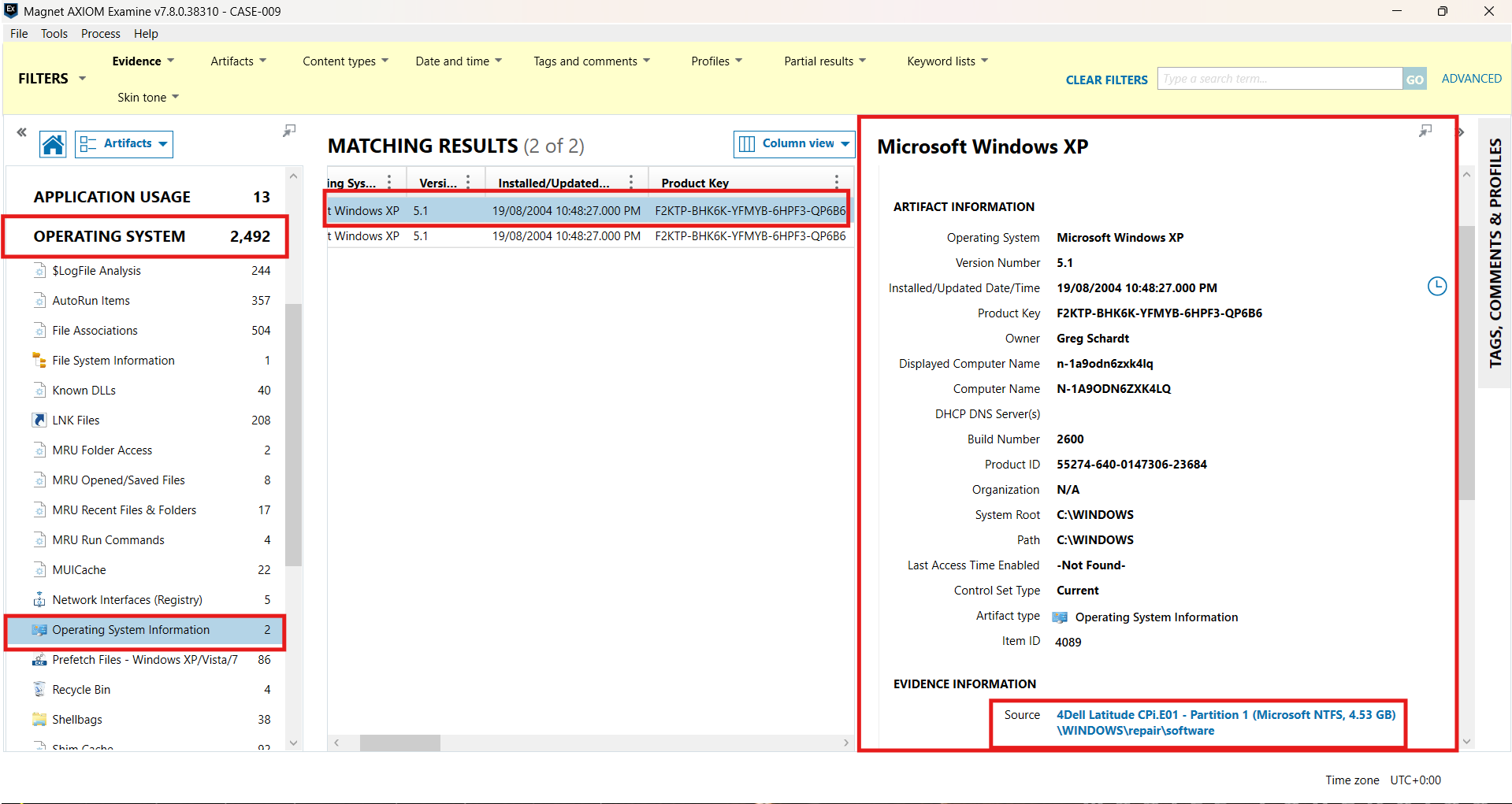
Figure 1
Operating system information in the AXIOM evidence image
2. Attribution and user context
The SOFTWARE Registry associates the installed operating system with registered owner Greg Schardt. The SAM/User Accounts artifacts identify Mr. Evil as an enabled local account with RID 1003 in the Administrators group. The observed user profile directory is Documents and Settings\Mr. Evil. Registry values and user-profile context support account-level attribution, but do not uniquely identify the human actor behind each individual event.
Figure 2
Mr. Evil account attributes and administrative membership
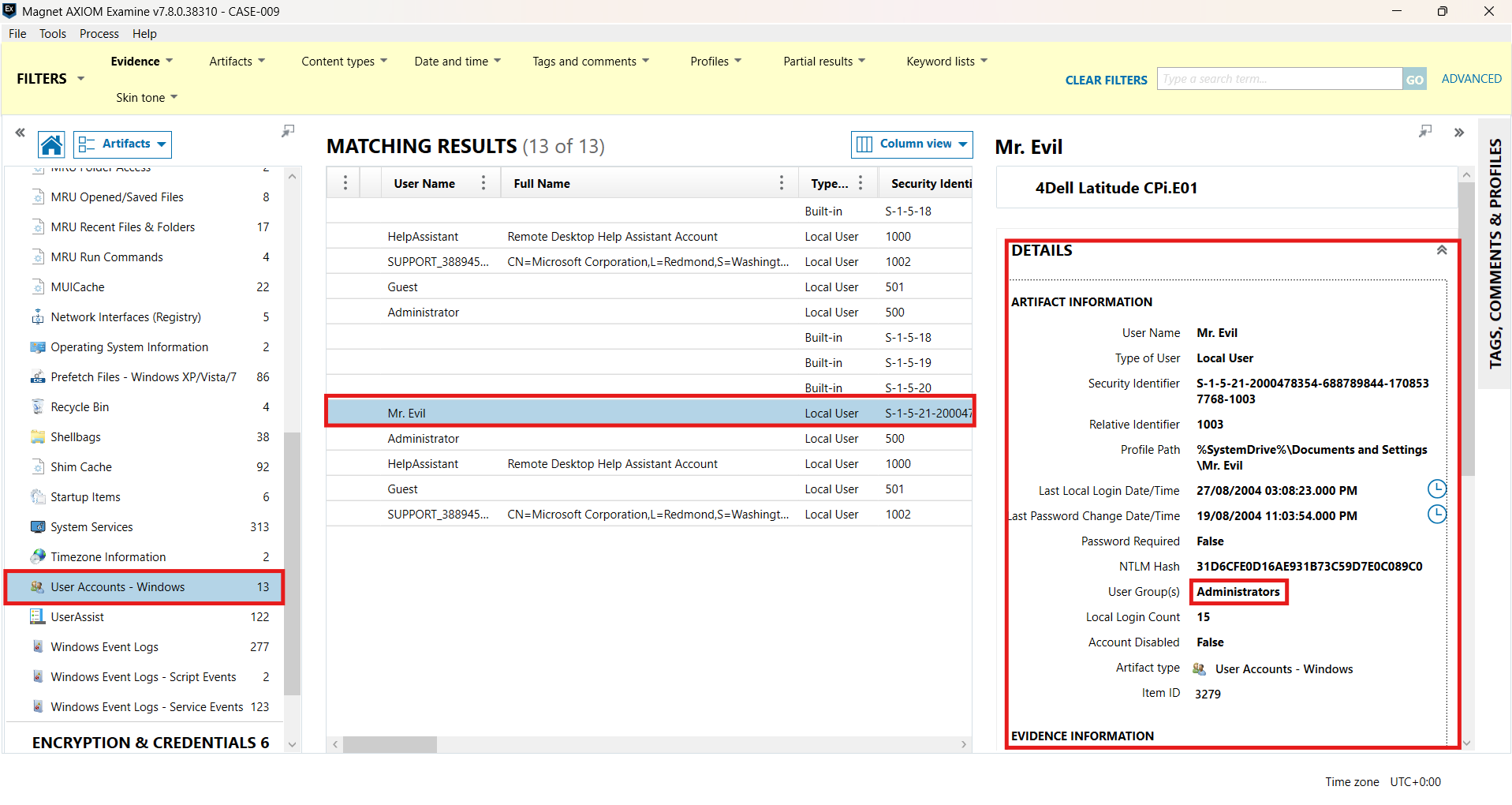
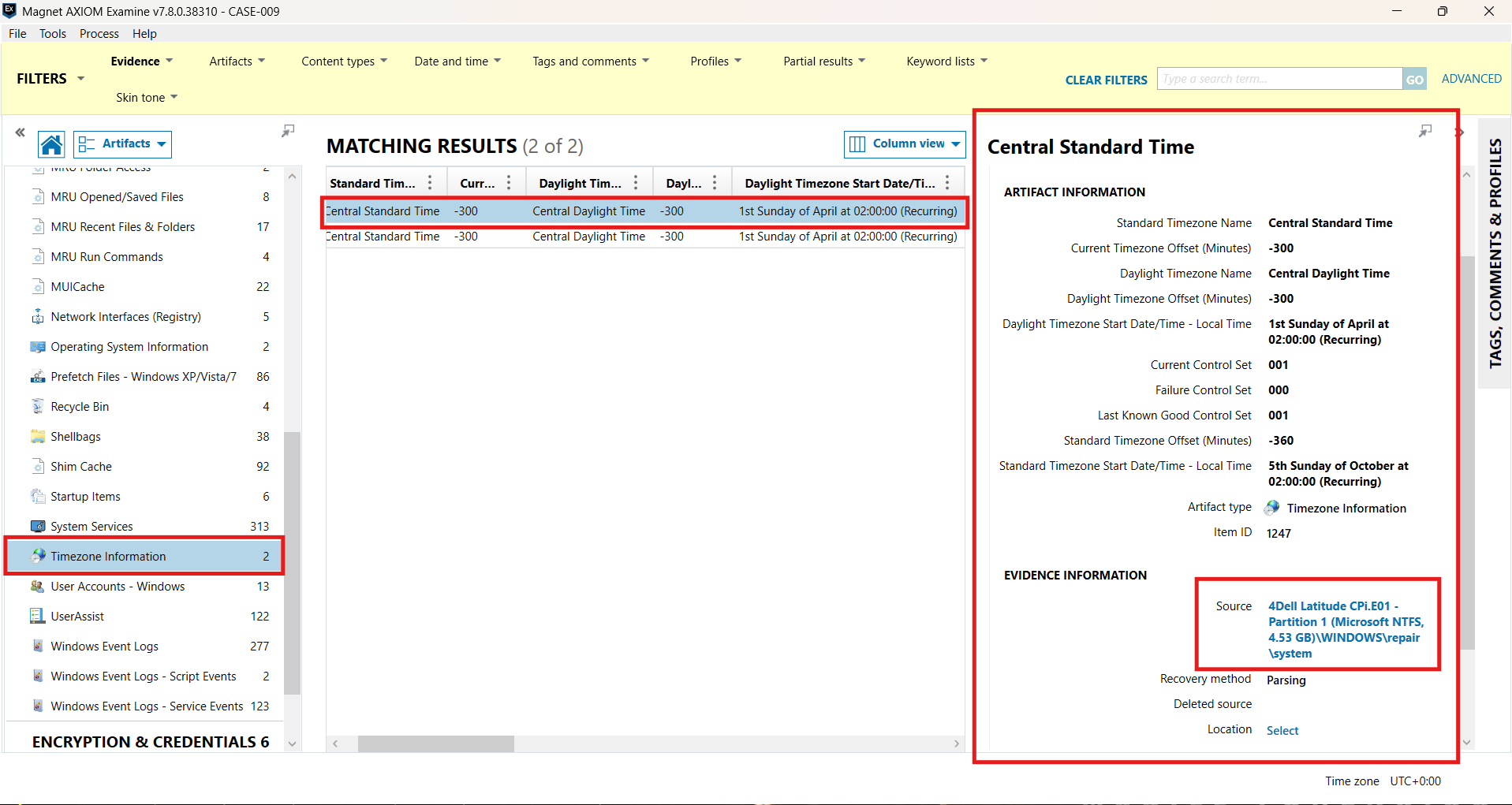
Figure 3
Configured Central time zone (summer daylight offset differs from UTC display)
3. Network and security tools
Desktop Tools shortcuts point to Cain, Ethereal, mIRC, NetStumbler, Look@LAN, CuteFTP, and other utilities. The installation of tools alone does not show malicious use. The Prefetch records provide stronger evidence of application execution at the system level; they do not reliably identify the logged-on person who launched an application.
| Artifact | Observed result |
|---|---|
| CAIN.EXE Prefetch | Run count 2; last run 27 Aug 2004 15:33:03 UTC |
| ETHEREAL.EXE Prefetch | Run count 1; last run 27 Aug 2004 15:34:54 UTC |
| Cain .LST files | Several zero-byte lists; modification times correlate with application activity, not password recovery |
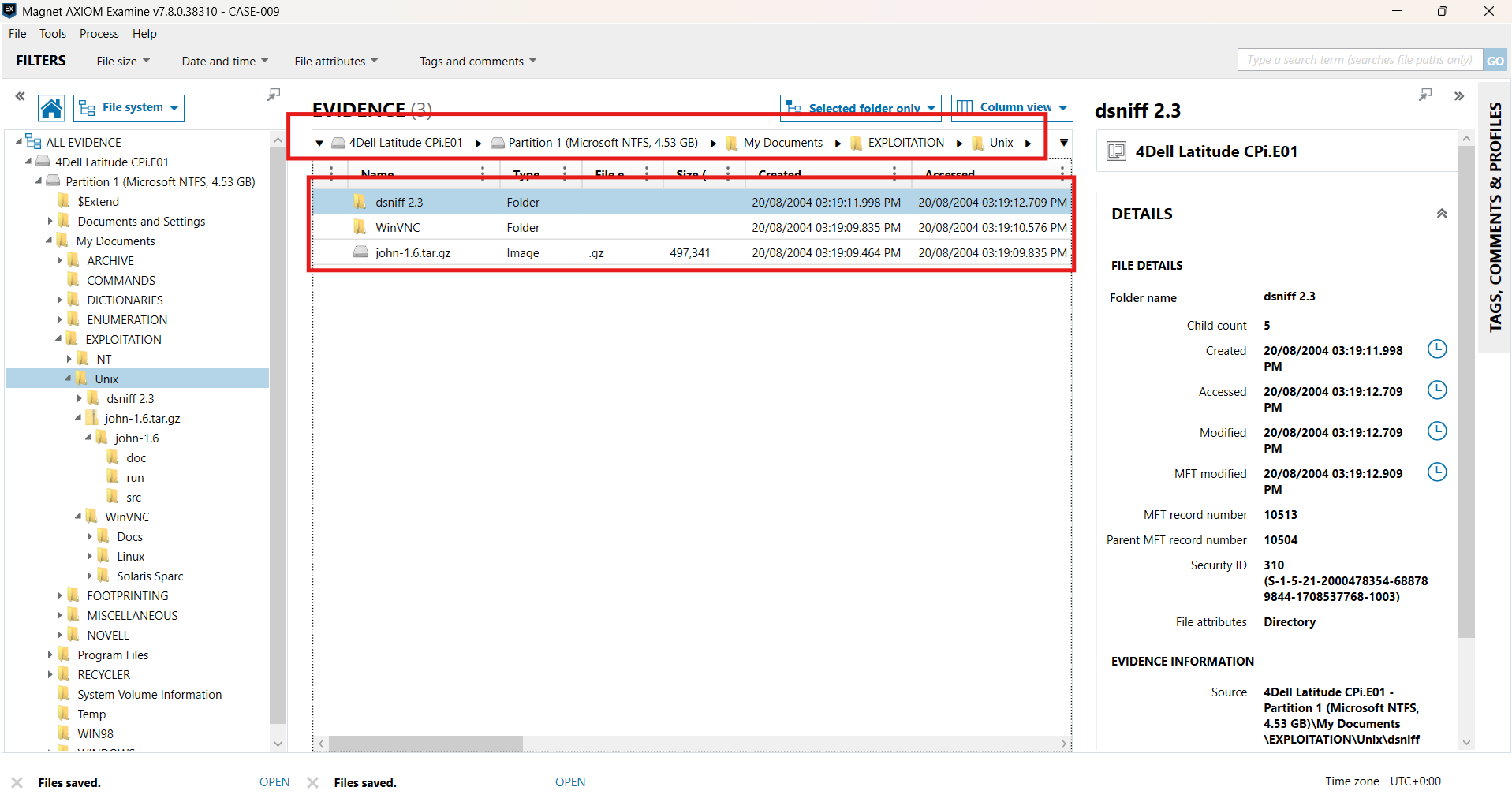
| EXPLOITATION\Unix | dsniff 2.3, WinVNC, john-1.6.tar.gz present |
| FOOTPRINTING\UNIX | unix_hack.tgz, 73,498,201 bytes; toolkit packaging documented by adjacent readme |
Figure 4
Cain Prefetch execution count and last run
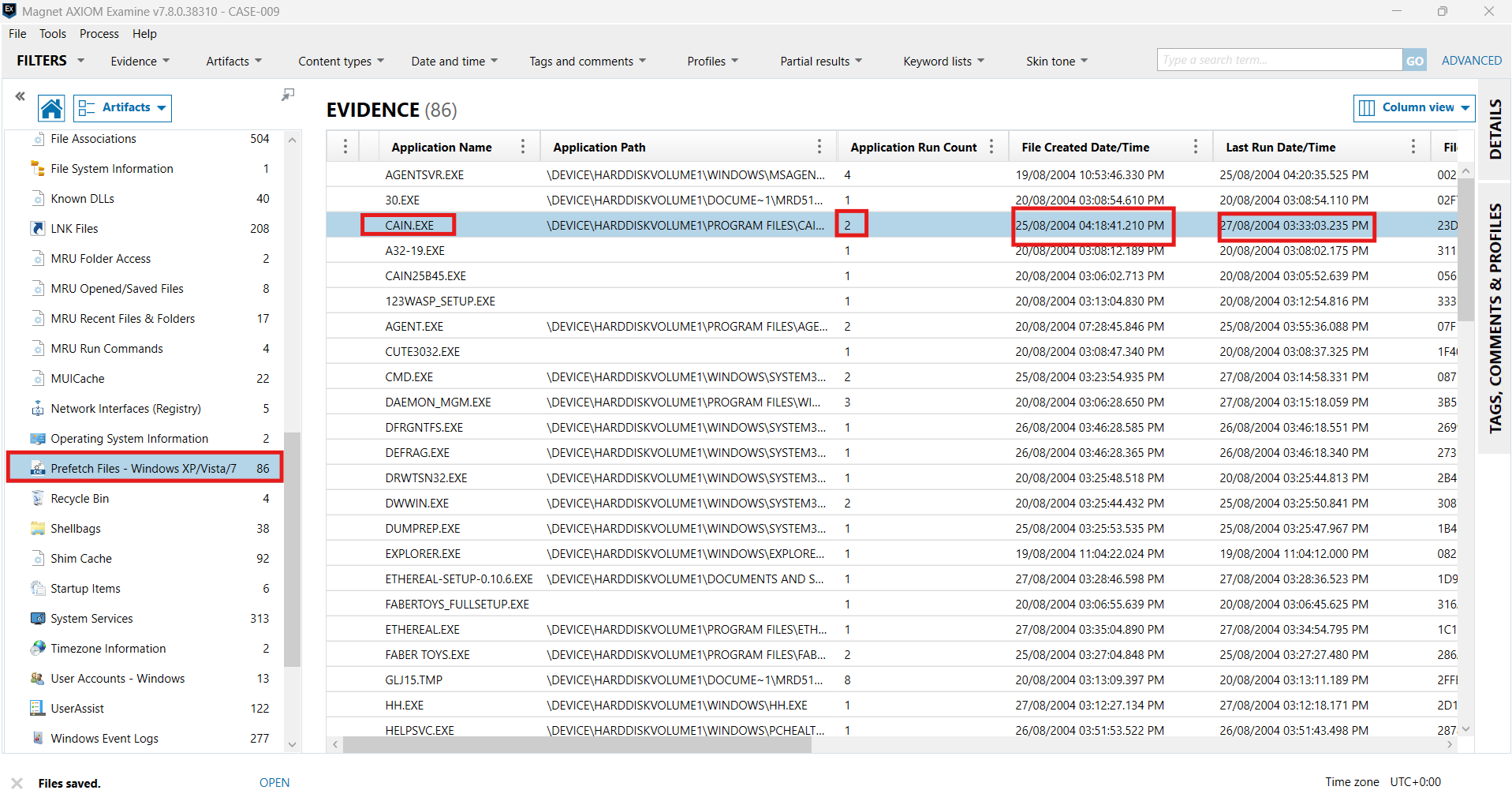
Figure 5
Ethereal Prefetch execution record
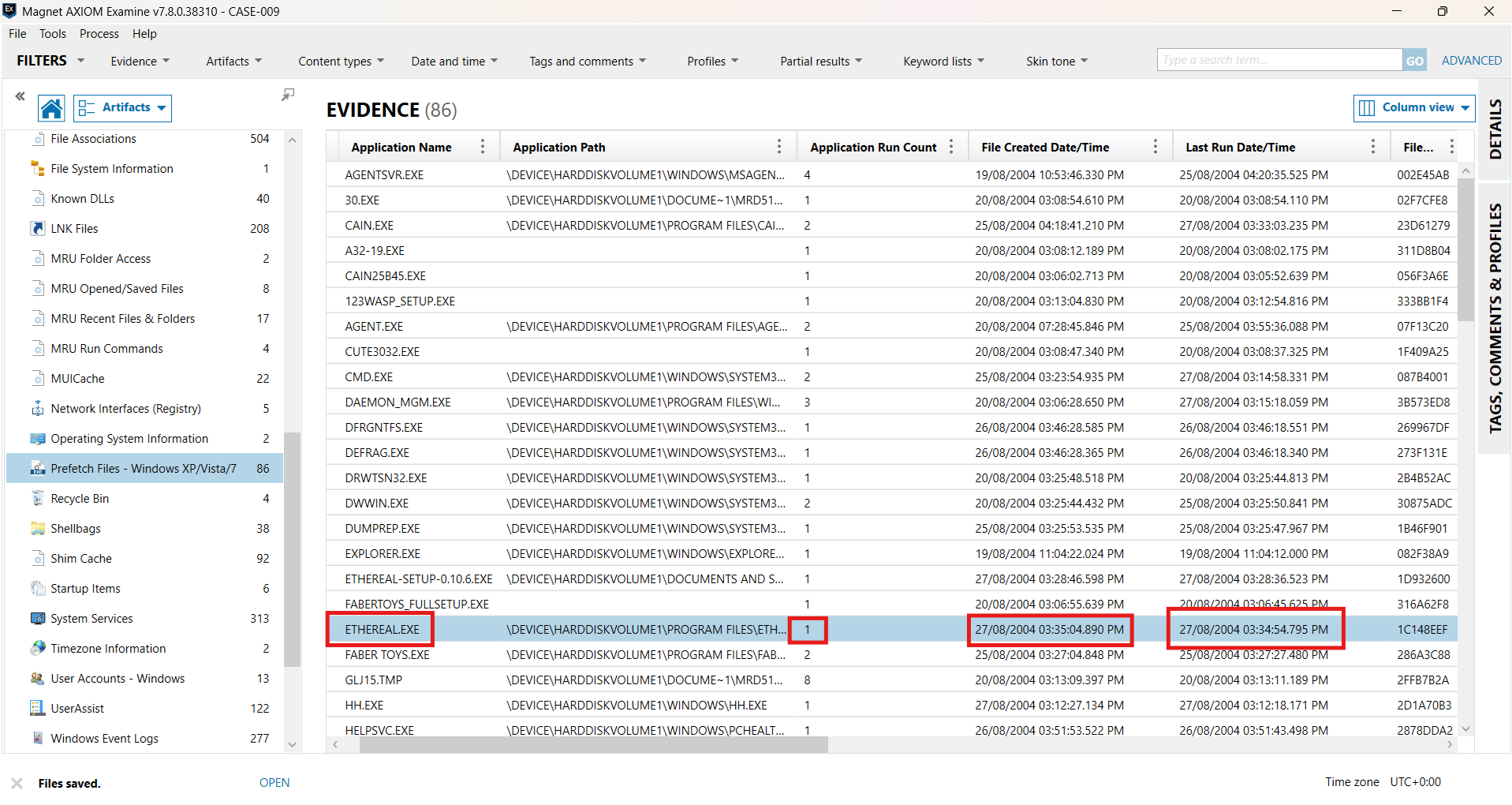
Figure 6
Offensive-tool archive in the EXPLOITATION directory
4. Deleted installation files
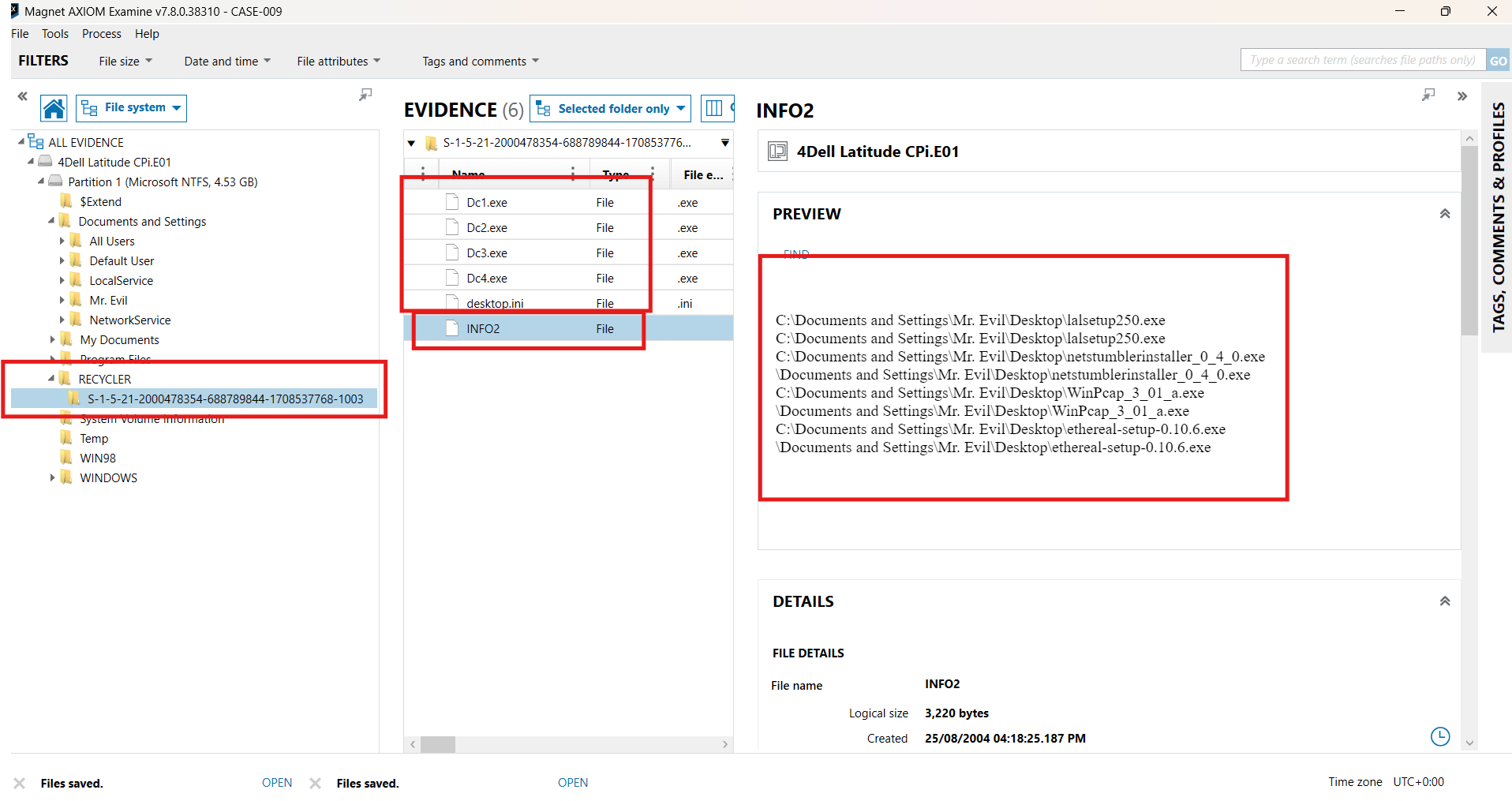
Within RECYCLER under the SID ending in 1003, four D*.exe entries were found. The Windows XP INFO2 index recorded their original Desktop paths, identifying the deleted entries as setup executables for network/security tools. Deletion does not demonstrate concealment intent.
| Recycled name | Original Desktop filename |
|---|---|
| Dc1.exe | lalsetup250.exe |
| Dc2.exe | netstumblerinstaller_0_4_0.exe |
| Dc3.exe | WinPcap_3_01_a.exe |
| Dc4.exe | ethereal-setup-0.10.6.exe |
Figure 7
INFO2 preview preserving original paths and filenames
5. Network share interaction
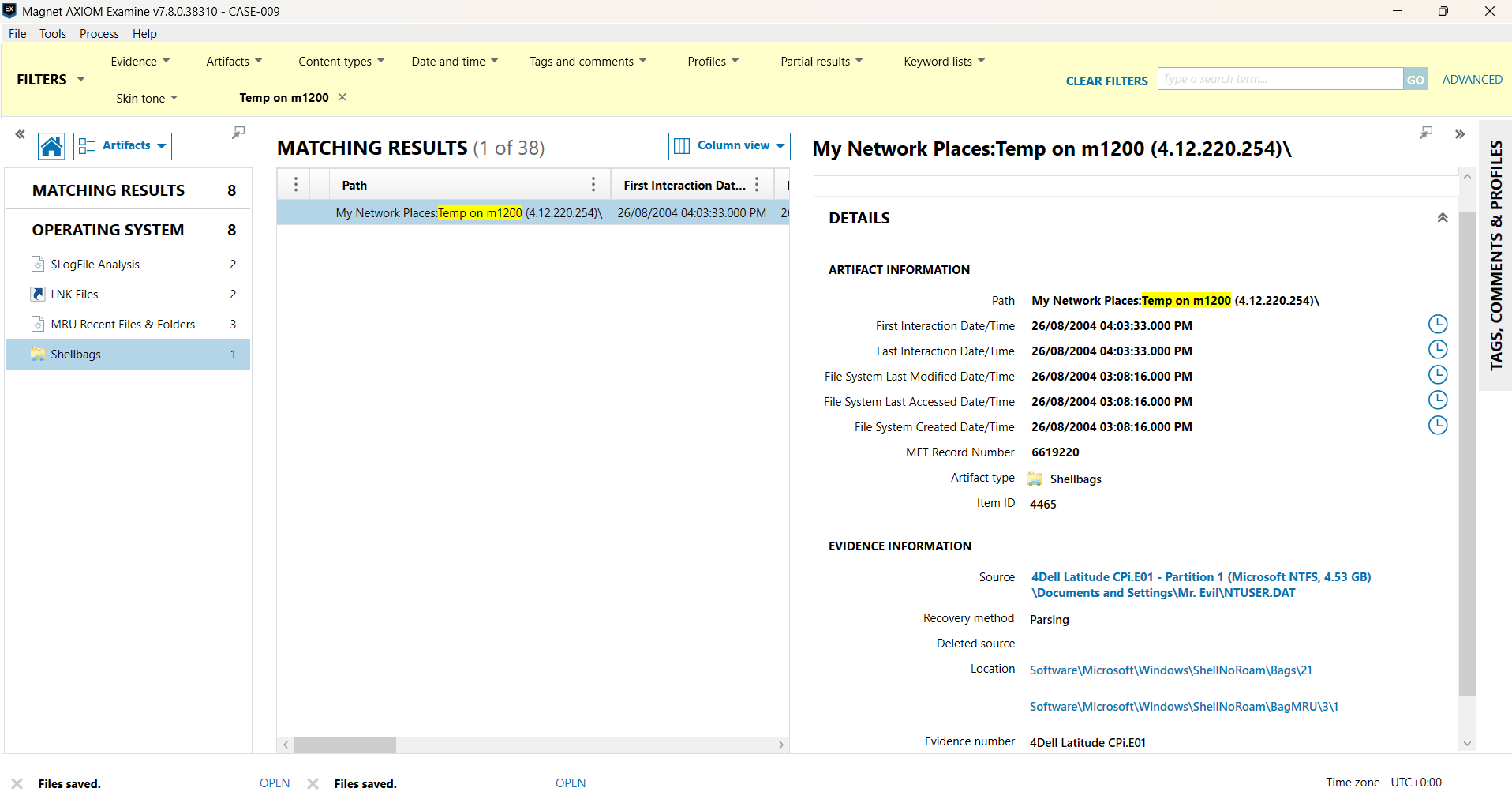
A shortcut inside Mr. Evil\Recent resolves to \\4.12.220.254\TEMP, shown in the Windows UI as Temp on m1200. RecentDocs and Shellbags independently reference the same network location. The shortcut contains target-directory metadata and a MAC address 00:02:3F:B3:E5:70. Together these are evidence of interaction with a network-share location, not proof of privilege bypass or transfer of particular files.
Figure 8
LNK target, dates and MAC information for the remote TEMP share
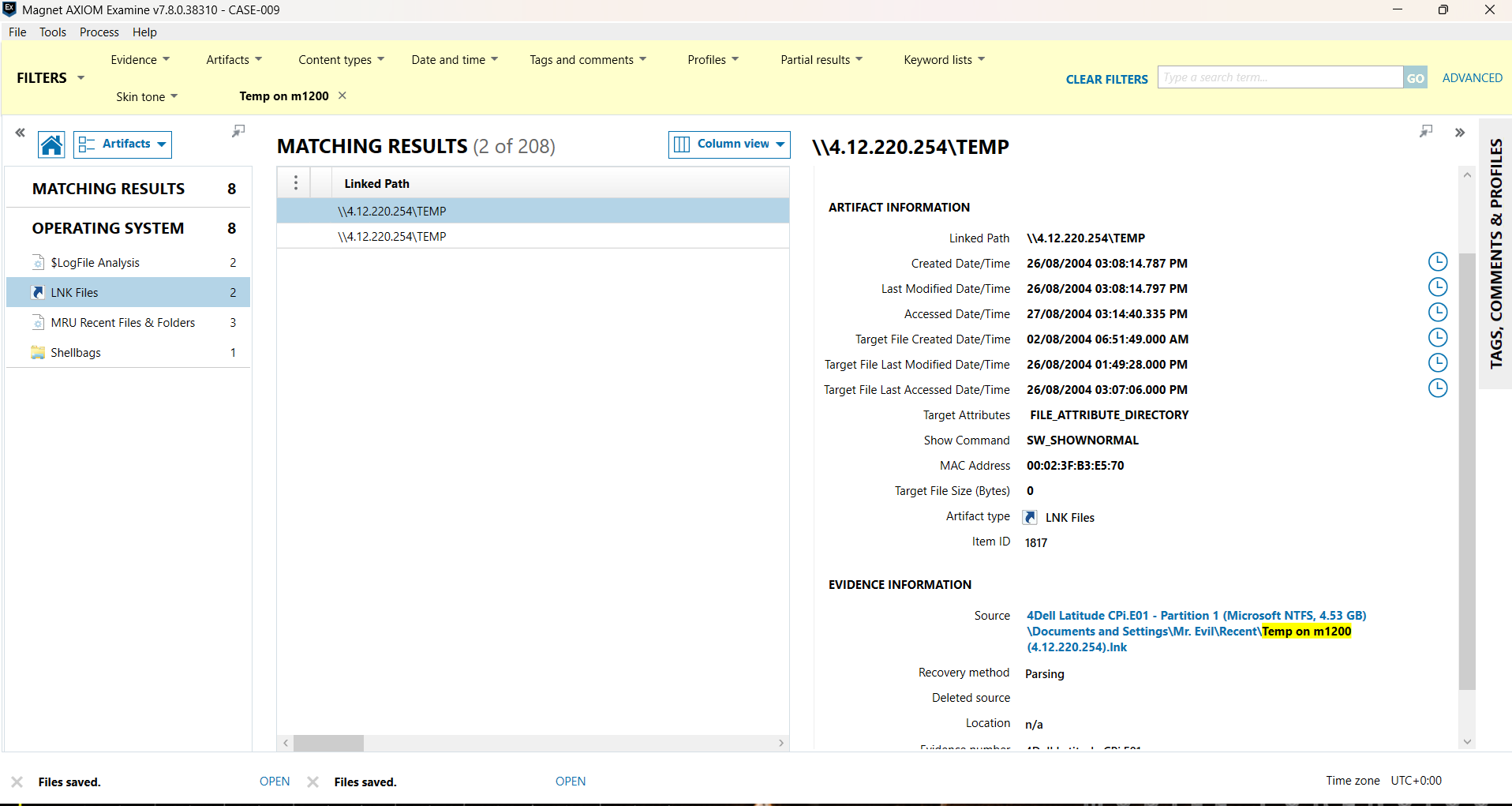
Figure 9
Shellbags record for Temp on m1200 in Mr. Evil NTUSER.DAT
6. Recovered packet capture and webmail activity
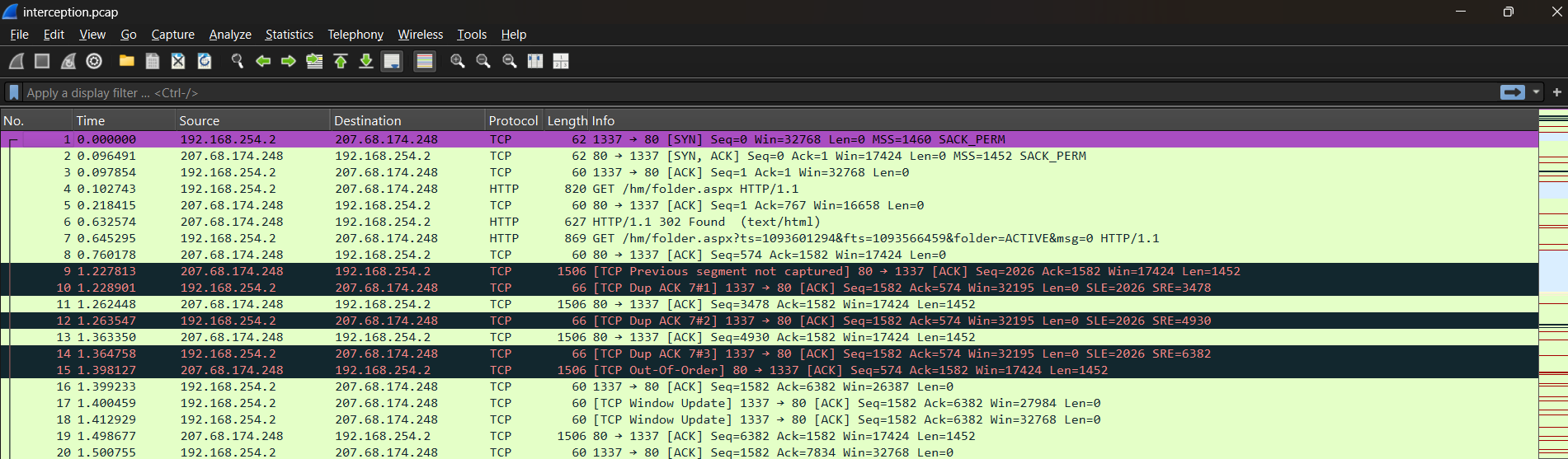
The profile file named interception, without a file extension, is a valid Ethernet PCAP. Packet parsing produced 459 frames spanning approximately 15:36:34 to 15:40:26 UTC on 27 August 2004. Its HTTP traffic primarily involves mobile.msn.com and Passport authentication hosts. The internal HTTP client address 192.168.254.2 is an endpoint visible inside the capture; it is not independently proven to be the seized laptop.
| Capture property | Observed value |
|---|---|
| Capture format | PCAP, Ethernet link type |
| Total frames | 459 |
| HTTP request count | 40, including 38 GET and 2 POST |
| Principal HTTP client | 192.168.254.2 |
| Email submission packet | Frame 113, 27 Aug 2004 15:37:55 UTC |
| Email submission endpoint | POST /hm/composeppc.aspx |
| Recipient | rudy@hotmail.com |
| Subject | Hey, This is Mr Evil |
| Message text | Hi. Call me |
| Response sequence | 100 Continue; 302 Found; redirected GET; 200 OK |
| Application confirmation | Message sent! |
Interpretation: the response body explicitly confirms that the Hotmail application accepted and reported the message as sent. This is stronger than a redirect alone, but it does not prove delivery to the recipient mailbox. The HTTP headers advertise a Windows CE Pocket PC user agent; this can be spoofed and is not sufficient to prove a physical mobile device. Captured authentication cookies are intentionally excluded from this report.
Figure 10
Wireshark PCAP packet list, including traffic between 192.168.254.2 and 207.68.174.248
7. Browser, communications, and external tools
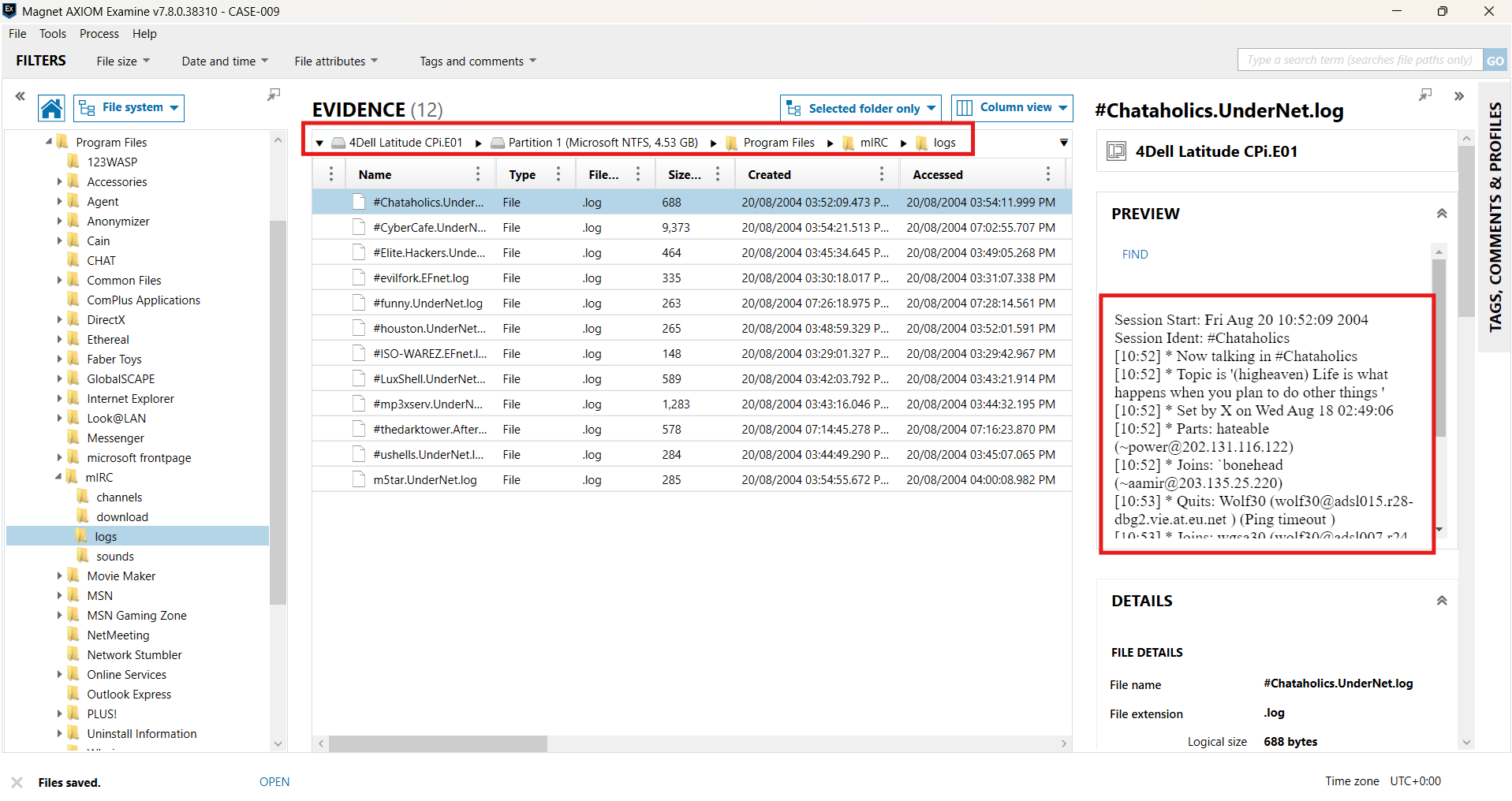
Internet Explorer history attributed to the Mr. Evil profile shows pages associated with network discovery and offensive-security interest, including NetStumbler, WarDriving.com, Ethereal, WinPcap, Anonymizer and 2600. A page title reading “hacking files” is a browser-title artifact, not proof that a local file of that name existed. mIRC channel logs show activity recorded on 20 August 2004, but their content does not establish unauthorized intrusion. Anonymizer keys.txt was referenced by a shortcut whose target was a CD-ROM drive path, not a confirmed file resident on this NTFS partition.
Figure 11
Selected Internet Explorer history pages attributed to Mr. Evil
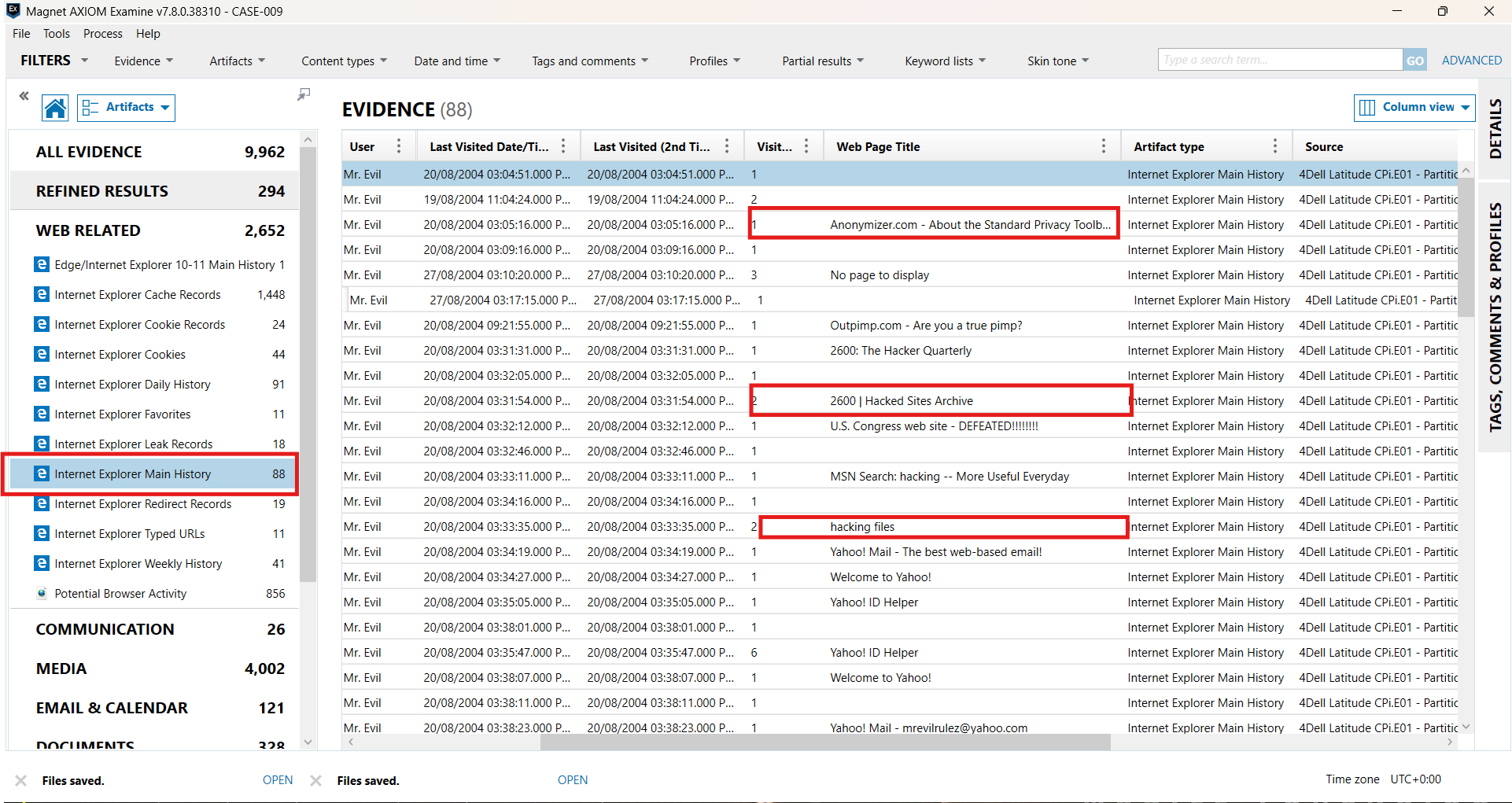
Figure 12
Removable-media shortcut to Anonymizer keys.txt
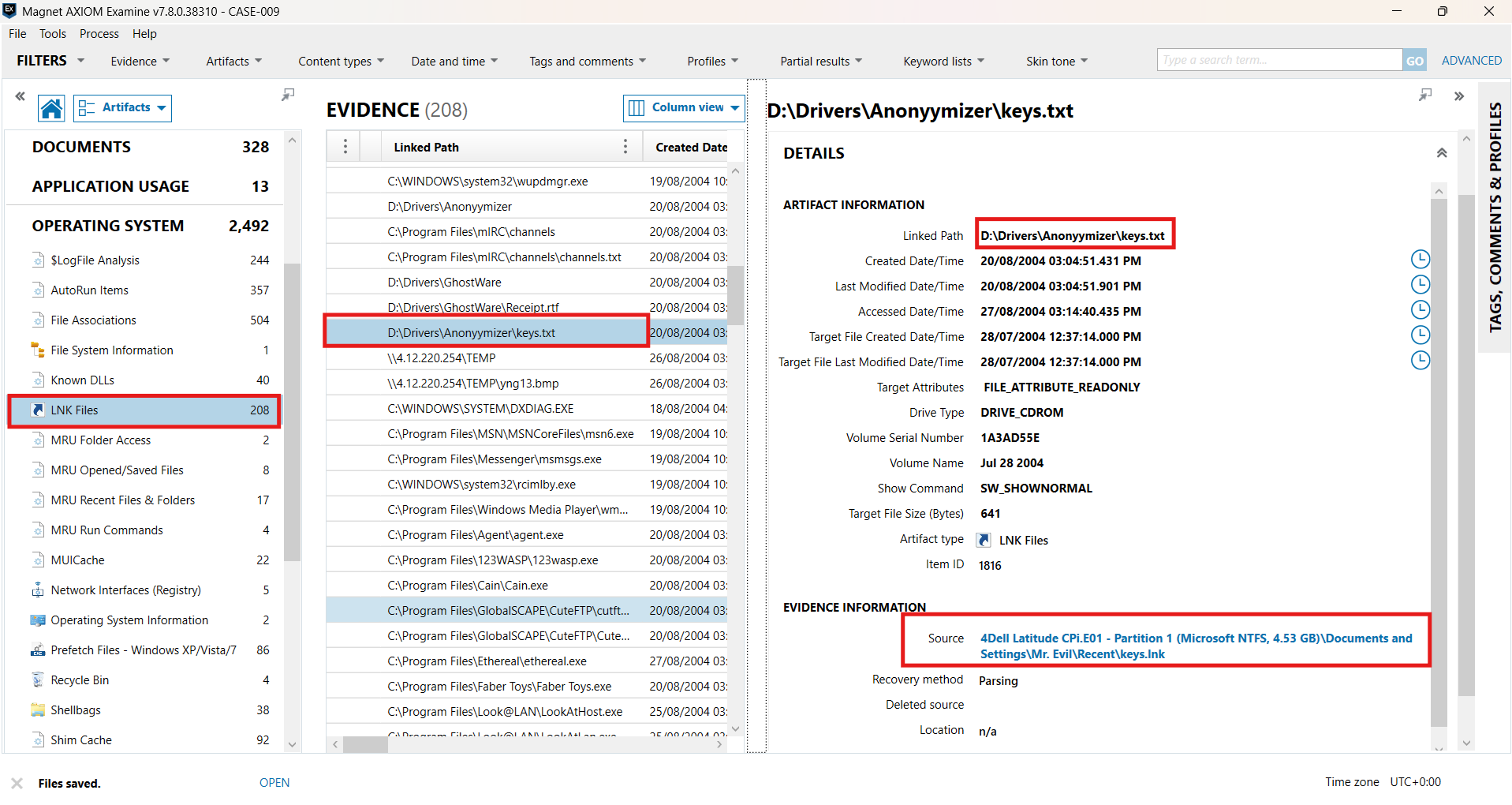
Figure 13
mIRC channel log evidence
8. Consolidated event sequence
| UTC date and time | Correlated observation |
|---|---|
| 20 Aug 2004 15:19 | Toolkit archive unix_hack.tgz created in image file system |
| 26 Aug 2004 15:08 | Shortcut to remote TEMP share created |
| 27 Aug 2004 15:14 | Remote-share shortcut last-access timestamp |
| 27 Aug 2004 15:33:03 | CAIN.EXE Prefetch last-run time |
| 27 Aug 2004 15:34:54 | ETHEREAL.EXE Prefetch last-run time |
| 27 Aug 2004 15:36:34 to 15:40:26 | PCAP network traffic interval |
| 27 Aug 2004 15:37:55 | Hotmail POST and server “Message sent!” response |
| 27 Aug 2004 15:41:00 | interception file creation/modification timestamp |
The temporal proximity of Cain and Ethereal execution to the captured traffic supports a working hypothesis of local network-analysis activity. It does not, without process-level provenance, prove which tool wrote the PCAP or who was operating the keyboard.
9. Findings and limitations
| Finding | Confidence | Boundary |
|---|---|---|
| Mr. Evil profile and administrative account | High | A user account, not a biometric identity |
| Cain and Ethereal execution | High | Prefetch is host-level execution evidence |
| Remote share interaction | Moderate to high | No proven unauthorized access |
| PCAP contains captured HTTP exchange | High | Capture author and network vantage point unknown |
| Hotmail application confirmed send | High | Not proof of inbox delivery |
| Successful hacking or credential theft | Not established | No validated target-side compromise evidence |
The available image does not include verified target-host telemetry, ISP/hotspot records, packet-capture chain of creation, or proof that the network session was obtained without permission. Event ID 592 was not found during the AXIOM review; Windows XP also does not normally retain complete command-line arguments in legacy process-creation events. The evidence therefore supports suspicious reconnaissance/interception-related activity but not a definitive allegation of successful compromise.
10. Final assessment
The strongest supported conclusion is that the examined laptop and Mr. Evil profile were associated with network exploration, use of sniffing-capable tools, and preservation of an HTTP packet capture containing a Hotmail email submission acknowledged by the service. No examined artifact independently establishes a successful unauthorized login, exploited vulnerability, or exfiltration from a third-party system. The case is accordingly assessed as corroborated security-tool and packet-capture activity, with unauthorized intrusion unproven.
Evidence references
The numbered figures reproduce screenshots from the examiner’s supplied evidence archive or screenshots shared during the investigation. Specific filenames and timestamps may be rechecked in the original Magnet AXIOM case. The separate interception capture was parsed and hash-verified as an exported working copy. No whole-image hash or tool-generated comprehensive export was supplied for this report.