Case 3
Windows host compromise: service persistence and suspected data staging
Reconstructed an RDP logon, a malicious coreupdater.exe service and access to loot.zip from a Windows E01 using FTK Imager and Zimmerman tools. Compromise confirmed; exfiltration not proven.
Access
Confirmed
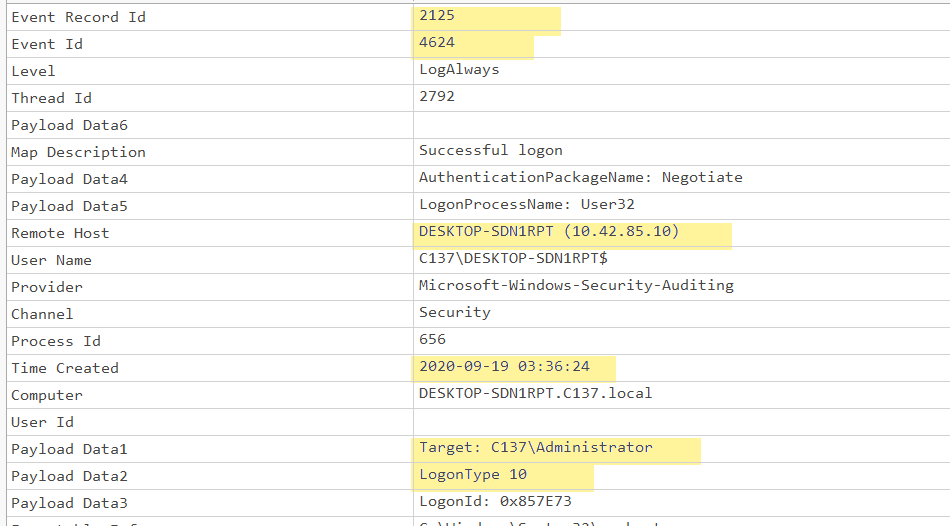
Event 4624: Administrator, logon type 10 from 10.42.85.10 at 03:36 UTC.
Executed
Confirmed
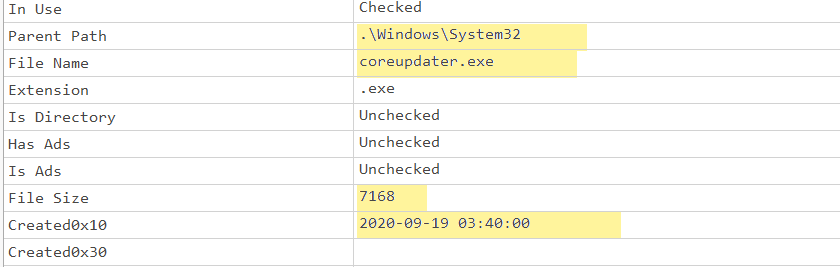
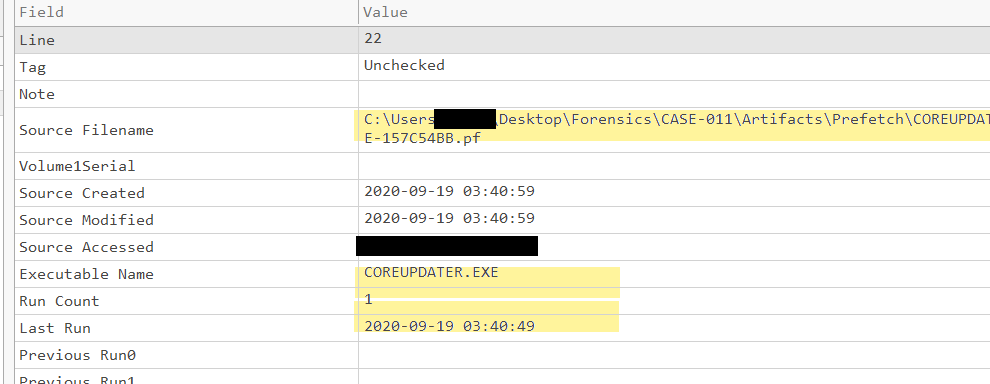
coreupdater.exe lands in System32 at 03:40 and runs at 03:40:49.
Persistence
Confirmed
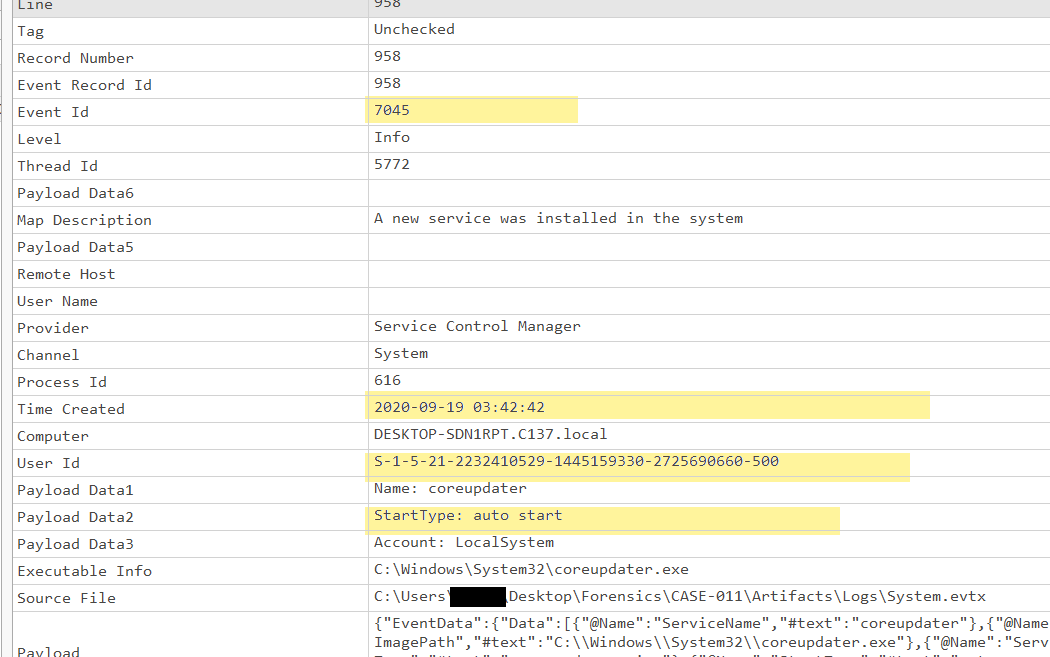
An auto-start LocalSystem service, and Event 7045 at 03:42:42.
Malicious
Confirmed
VirusTotal: 64 of 71 vendors flag the sample.
Staging
Confirmed
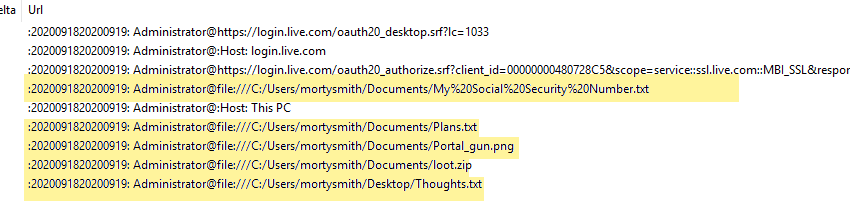
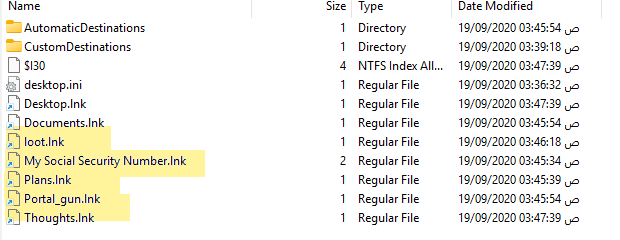
WebCache and loot.lnk point to mortysmith's loot.zip.
Network use
Confirmed
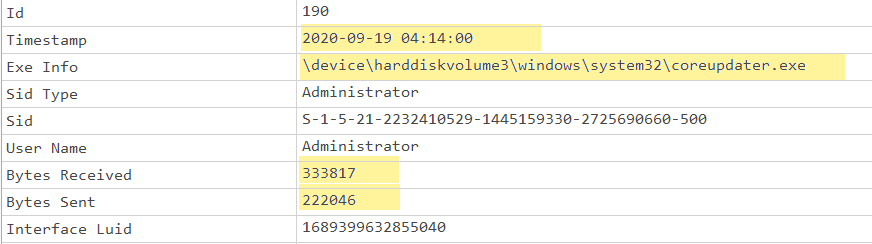
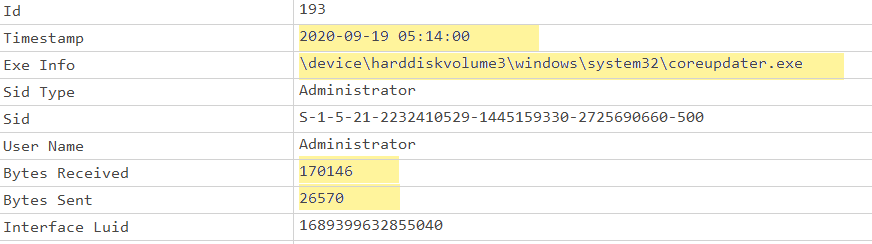
SRUM: coreupdater.exe sent 248,616 bytes in two hourly buckets.
Exfiltration
Not proven
No archive, destination or transfer record was recovered.
Case CASE-011: Windows host compromise and suspected data staging
DFIR evidence report · version 1.4 · acquisition-to-analysis evidence. A defensible, artifact-led reconstruction of privileged access, service persistence, document activity, and network usage.
| Item | Value |
|---|---|
| Prepared by | Turki Adnan Abbas · تركي عدنان عباس |
| Examined host | DESKTOP-SDN1RPT.C137.local |
| Primary window (UTC) | 19 Sep 2020 03:36–05:14 |
| Assessment | Compromise: high confidence · Exfiltration: unconfirmed |
Case-study report, revised to show the artifact extraction and analysis folder inventories (Figs 03–04). Findings are derived from an acquired Windows E01 image, offline event/registry artifacts, parsed artifact exports and analyst-provided screenshots. Case claims are separated from leads and data gaps. The specific E01 acquisition hash was not supplied and is not asserted here; a locally computed ZIP package fingerprint is separately documented in Fig 02.
Authoritative evidence hierarchy. Host-generated artifacts → cross-parser corroboration → third-party reputation intelligence. Transparent yellow marker strokes identify observed values in enlarged screenshot crops while retaining the original lettering and numbers. Original source captures remain unchanged; source paths accompany every plate.
01. Executive assessment
Bottom line. The examined workstation experienced privileged interactive access followed within minutes by placement, execution, and installation of a highly suspicious executable as an auto-start Windows service. Two independent host artifacts subsequently attribute network usage to that executable. Separately, the Administrator profile records access to another user’s private documents and a shortcut to an archive named loot.zip. The evidence supports compromise and plausible data staging; it does not prove the archive was transmitted off-host.
| Question | Answer | Rationale / evidence |
|---|---|---|
| Was a privileged session observed? | YES — observed | RDP-style Event 4624, LogonType 10, C137\Administrator, 03:36:24 UTC (Fig 11). |
| Did coreupdater.exe execute? | YES — high confidence | MFT placement; Prefetch RunCount=1 at 03:40:49; Amcache hash linkage (Figs 13–15 and 20). |
| Was persistence established? | YES — confirmed | Auto-start service registry entry and System 7045 installation at 03:42:42 (Figs 16–18). |
| Was a suspicious archive referenced? | YES — observed | WebCache URL and Administrator Recent\loot.lnk refer to Morty user’s loot.zip (Figs 23–25). |
| Did malware use the network? | YES — application attributed | Two SRUM records, 248,616 sent bytes across recorded buckets (Figs 27–28). |
| Was data exfiltration proven? | NO — unresolved | No recovered archive, destination-specific traffic, packet evidence, proxy logs, or clear file-transfer audit. |
Confidence designations. CONFIRMED = directly recorded by native host artifacts, usually with corroboration. SUPPORTED = multiple related but indirect observations. POSSIBLE = inference requiring additional telemetry. UNCONFIRMED = insufficient proof to assert the event occurred.
Time basis: parsed artifact timestamps are reported in UTC where the parser indicates UTC. The offline SYSTEM registry names Pacific Standard Time with ActiveTimeBias=420 minutes (Fig 07), so local display and parser time should not be conflated. SRUM timestamps are periodic usage buckets, not exact per-packet connection times.
02. Case scope and method
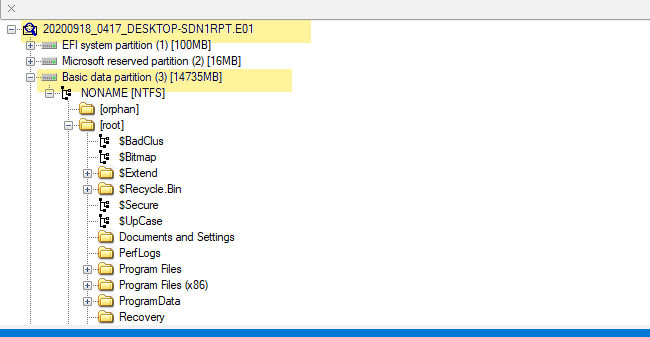
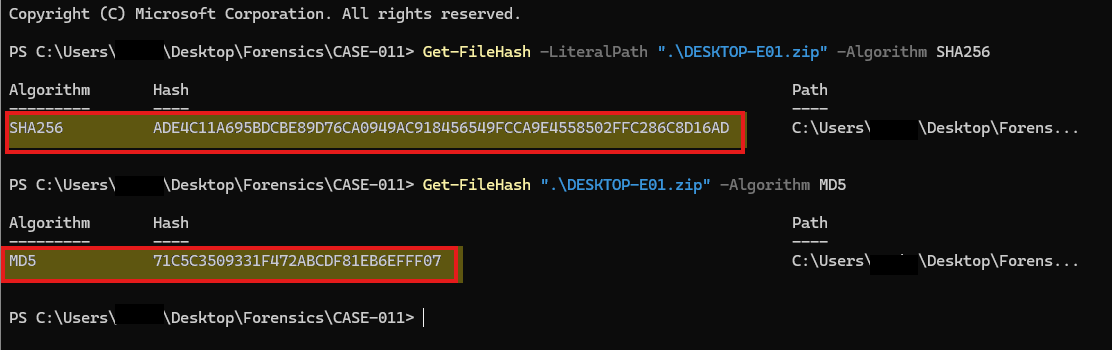
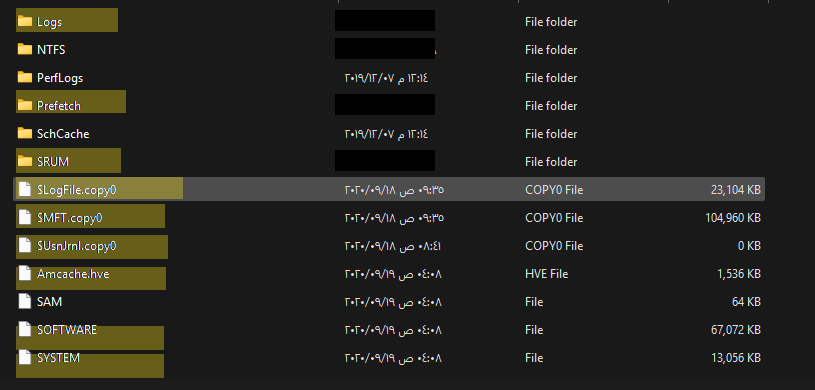
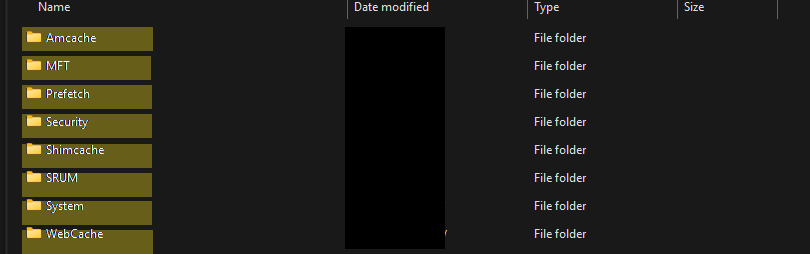
Examined evidence: forensic image 20200918_0417_DESKTOP-SDN1RPT.E01 (Fig 01), the collected artifact inventory (Fig 03: $MFT.copy0, $LogFile.copy0, $UsnJrnl.copy0, Amcache.hve, SAM, SOFTWARE, SYSTEM, Logs, Prefetch, SRUM and other folders), and the eight artifact-specific processing folders (Fig 04). The analysis used exported $MFT, registry hives, Security/System EVTX, Prefetch, Amcache, Windows WebCache ESE database, SRUDB.dat, Windows Recent Items, and screenshot/CSV review records. A PowerShell screenshot records local hash calculations of DESKTOP-E01.zip (Fig 02); these are not E01 hashes and no matching acquisition manifest was provided. The screenshots establish a working inventory but do not prove extraction completeness, origin of every listed file or verified bitstream integrity.
Acquisition-to-analysis trace: Fig 01 documents the mounted E01; Fig 02 the local ZIP fingerprint; Fig 03 the copied forensic artifact working set; and Fig 04 the organized parser-output folders. The two File Explorer views do not expose address bars, so parent working-directory paths in their captions are corroborated or reconstructed from the separately captured Security.evtx parser command, not represented as independently screenshot-verified addresses.
Workflow: (1) identify OS/host; (2) normalize native logs into CSV; (3) isolate RDP session and privilege events; (4) pivot on executable file and service; (5) validate execution with Prefetch/Amcache; (6) inspect local-file browser history and shortcuts; (7) examine SRUM; (8) attempt deletion/network corroboration; (9) constrain conclusions to the available proof.
03. Reconstructed timeline (UTC)
| UTC | Observation | Source | Evidence status |
|---|---|---|---|
| 19 Sep 03:36:24 | C137\Administrator RemoteInteractive / LogonType 10, source 10.42.85.10 | Security 4624 / Fig 11 | Observed; IP ownership unresolved |
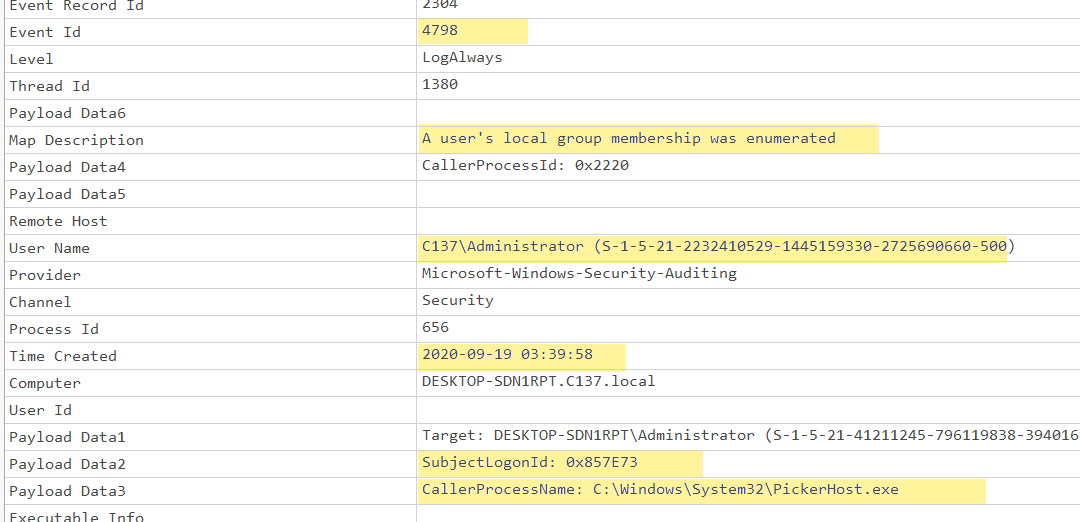
| 03:39:58 | Account/local group enumeration; same session LogonId | Security 4798 / Fig 12 | Observed; intent not established |
| 03:40:00 | coreupdater.exe created in C:\Windows\System32, 7,168 bytes |
$MFT / Fig 13 | Observed |
| 03:40:49 | coreupdater.exe Prefetch last execution; RunCount=1 | PECmd / Fig 14 | Observed execution |
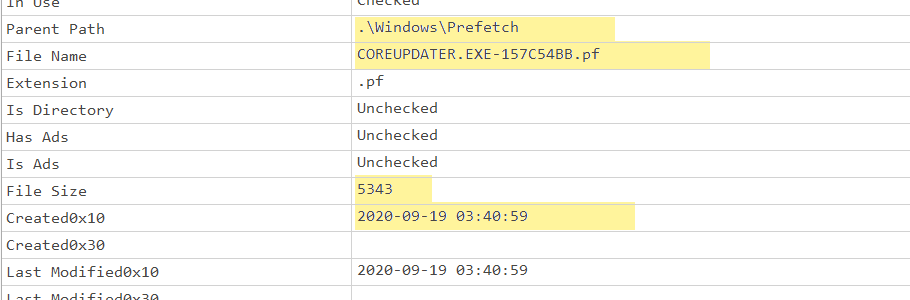
| 03:40:59 | Prefetch file creation | $MFT / Fig 15 | Corroborated |
| 03:42:42 | Auto-start service coreupdater installed; LocalSystem | System 7045 + Registry / Figs 16–18 | Confirmed persistence |
| 03:45:34–03:47:39 | Local file history for Morty documents including loot.zip | WebCache + Recent LNK / Figs 23–25 | Observed references; content unresolved |
| 04:14 bucket | coreupdater.exe — 222,046 sent, 333,817 received | SRUM / Fig 27 | Observed aggregate usage |
| 05:14 bucket | coreupdater.exe — 26,570 sent, 170,146 received | SRUM / Fig 28 | Observed aggregate usage |
The ordered activities are consistent with the sequence access → payload placement → execution → persistence → local-document interaction → ongoing network use. The timeline alone cannot prove a single human operator or a file-specific outbound transfer.
04. Technical findings
F-01: Interactive access and privileged activity
Security.evtx Record 2125 contains Event 4624 for C137\Administrator at 03:36:24 UTC with LogonType 10 and source address 10.42.85.10. The private source address could represent a DC, relay, jump host or other internal asset; owner and exposure require corroboration. Record 2304 (Event 4798) at 03:39:58 shares the relevant logon context, but its process name PickerHost.exe makes malicious intent a qualified hypothesis rather than a standalone fact. The SAM hive lists a separate local Administrator account (Fig 09), so the domain-scoped logon identity must not be equated to SAM presence. See Figs 09–12.
F-02: Malware execution and persistence
MFT Entry 26213 records a 7,168-byte coreupdater.exe under System32 with creation timestamp 03:40:00 UTC. Prefetch COREUPDATER.EXE-157C54BB.pf independently records one execution at 03:40:49 and was created by 03:40:59. The SYSTEM registry defines a service with the executable path, Automatic startup, and a LastWrite of 03:42:42. System.evtx Event 7045 records service installation at the same time under LocalSystem; the parsed compact service row is reproduced separately for field-level readability (Fig 18). These observations establish a host-resident executable and service persistence; no inference from file-name similarity alone is required. See Figs 13–18.
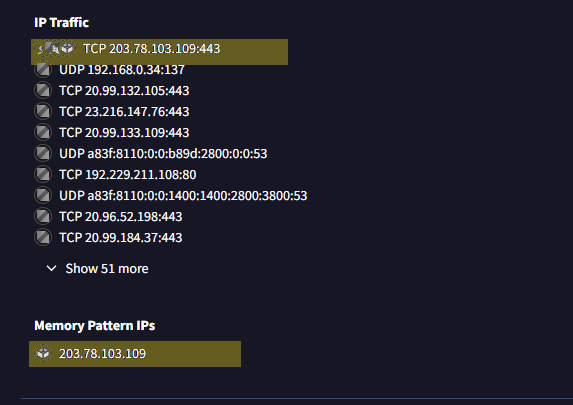
Sample reputation reports 64/71 detections. The Amcache SHA1 entry matches the submitted sample’s SHA1. The sandbox IP 203.78.103.109 is a candidate external IOC from isolated sandbox execution, not an observed endpoint connection. A local analyst VM Defender warning seen elsewhere during extracted-sample review must not be attributed to the historical target image. See Figs 19–21.
F-03: Sensitive document references and possible staging
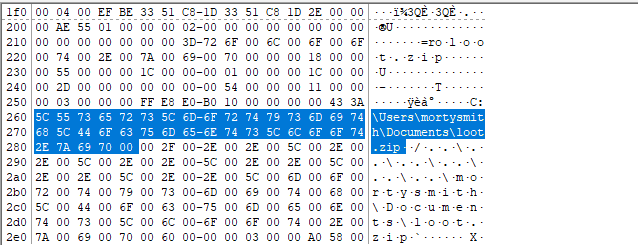
Administrator WebCache Container_8 holds local file-history references to the Morty user’s documents. Matching Recent Items shortcuts corroborate user-interface interaction. The shortcut loot.lnk embeds C:\Users\mortysmith\Documents\loot.zip as its target and advertises target size 131,041 bytes. This is compelling evidence that an archive path was referenced, but neither its byte contents nor its actual creation via an MFT entry was recovered. We therefore classify archive staging as plausible/supported, not as independently verified bulk collection. See Figs 22–25.
F-04: Post-installation network usage
SrumECmd parsed SRUDB.dat and the offline SOFTWARE hive to resolve AppId 433 to coreupdater.exe and UserId 428 to Administrator. ID 190 (04:14 bucket) reports 222,046 sent and 333,817 received; ID 193 (05:14 bucket) reports 26,570 sent and 170,146 received. Across these two records, 248,616 bytes were sent and 503,963 bytes received. SRUM does not provide destination IP, remote service, packet payload or identification of which files contributed to the bytes. This is communication/usage evidence, not file-exfil proof. See Figs 26–28.
F-05: Recovery and telemetry gaps
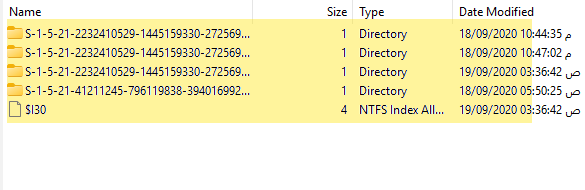
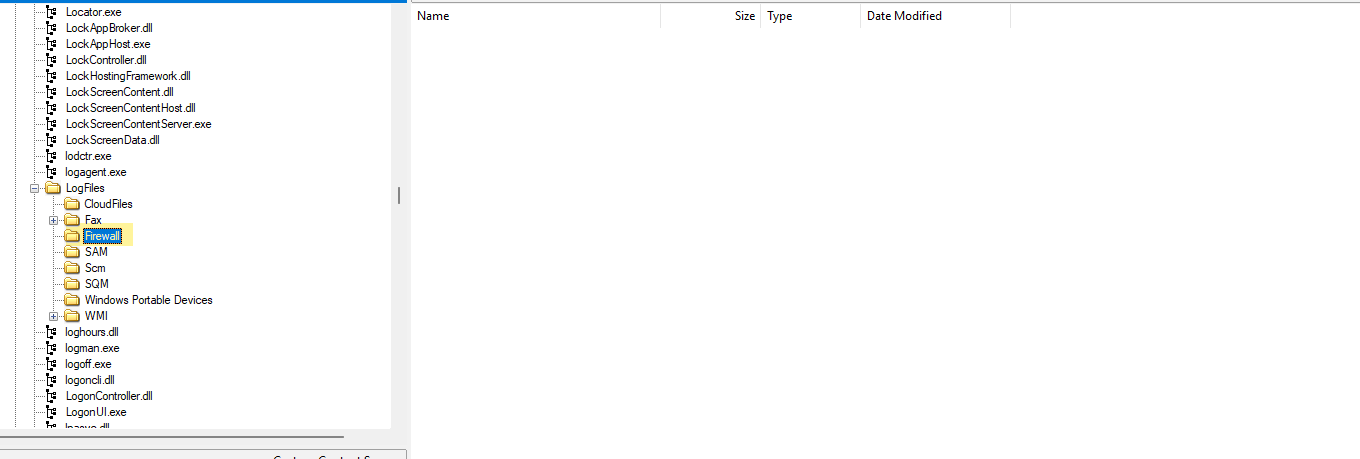
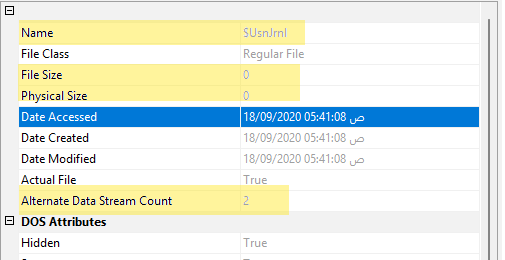
No loot.zip file was located in the exported MFT search and it did not appear in the inspected Recycle Bin directories. The inspected Firewall directory lacked pfirewall.log; Sysmon operational EVTX and file/network audit evidence were not available; the $UsnJrnl::$J recovery attempt was incomplete even though FTK showed alternate streams. The export inventory also shows $UsnJrnl.copy0 as 0 KB (Fig 03). These are limits of the examined sources, not proof that deletion or outbound transmission did not occur. See Figs 29–31.
05. Indicator register and controlled interpretations
| Artifact / indicator | Value | Origin and use |
|---|---|---|
| Host / domain | DESKTOP-SDN1RPT.C137.local | Host scoping; offline registry and event record |
| Service / image | coreupdater → C:\Windows\System32\coreupdater.exe |
Confirmed persistence; hunt equivalent service keys / image paths |
| SHA256 (malware sample) | 10f3b92002bb98467334161cf85d0b1730851f9256f83c27db125e9a0c1cfda6 |
Reputation sample; verify same file with independent image-extracted hash if available |
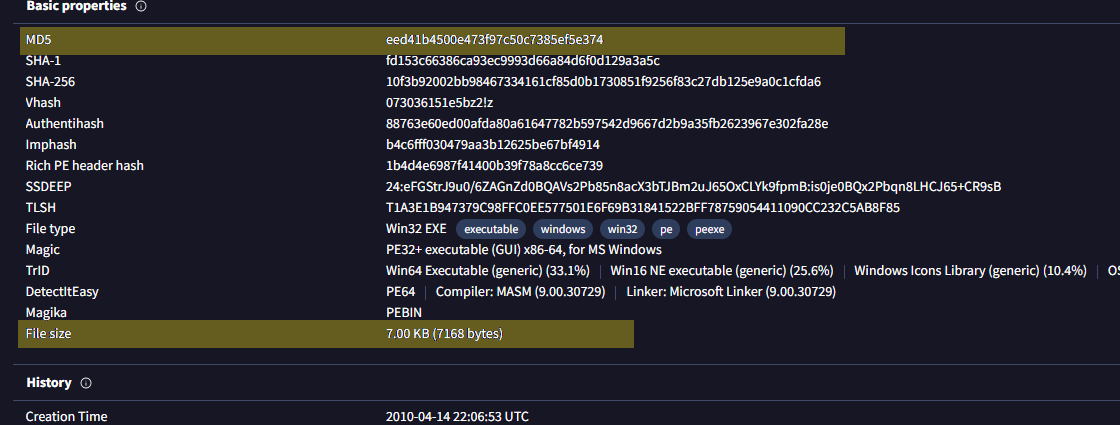
| SHA1 (Amcache + sample) | fd153c66386ca93ec9993d66a84d6f0d129a3a5c |
Confirmed hash agreement between sample and Amcache |
| MD5 (sample) | eed41b4500e473f97c50c7385ef5e374 |
Sample identity; not evidence of source host network |
| Source address (RDP) | 10.42.85.10 | Private network source; investigate DHCP/DC/VPN ownership |
| Candidate network IOC | 203.78.103.109 | VirusTotal sandbox ONLY; no observed victim connection |
| Archive target | C:\Users\mortysmith\Documents\loot.zip |
WebCache and LNK referral; source archive not recovered |
06. MITRE ATT&CK mapping
| Technique | Status | Evidence / caveat |
|---|---|---|
| T1021.001 — Remote Desktop Protocol | Observed behavior | Security 4624 LogonType 10; specific access origin/control unresolved. |
| T1078 — Valid Accounts | Consistent / not attribution | Successful domain Administrator interactive session. Does not prove credential theft. |
| T1543.003 — Windows Service | Confirmed | coreupdater auto-start service; registry + System 7045. |
| T1005 — Data from Local System | Possible | History/LNK refer to another profile’s documents; actual contents not recovered. |
| T1560.001 — Archive via Utility | Hypothesis only | loot.zip shortcut; archive creation tool / command line not identified. |
| T1041 — Exfiltration Over C2 Channel | NOT ESTABLISHED | SRUM outbound bytes without destination, content or proof of archive transfer. |
07. Toolchain and investigation traceability
The following inventory distinguishes tools visibly operated in the analyst workflow from outputs/parsers referenced by the supplied artifacts. Figures 03–04 show the collected source-file and analysis-folder inventories. Figure 10 preserves the actual EvtxECmd console syntax; any additional search/filter examples are illustrative and are not represented as historical console commands.
| Tool | Input / search pivot | Output / investigation purpose |
|---|---|---|
| FTK Imager 4.5.0.3 | 20200918_0417_DESKTOP-SDN1RPT.E01; file-system tree |
Browse/export artifacts, inspect LNK bytes, Recycle Bin, SRUM and logging paths. |
| PowerShell Get-FileHash | C:\Users\[redacted]\Desktop\Forensics\CASE-011\DESKTOP-E01.zip |
SHA-256 and MD5 locally computed for ZIP evidence package (Fig 02); no E01 hash verification. |
| Registry Explorer | SYSTEM, SOFTWARE, Amcache.hve | OS build/identity, ProfileList, services\coreupdater and LastWrite. |
| EvtxECmd | Security.evtx and System.evtx | Security_Analysis.csv, Event 4624/4798, System Event 7045. |
| MFTECmd | C:\$MFT |
MFT_Analysis.csv — executable and Prefetch file timestamps, filename searches. |
| PECmd | C:\Windows\Prefetch\*.pf |
[run time]_PECmd_Output.csv — run count, executable path, LastRun. |
| AmcacheParser | C:\Windows\AppCompat\Programs\Amcache.hve |
[run time]_Amcache_UnassociatedFileEntries.csv — SHA1 and file inventory. |
| AppCompatCacheParser | SYSTEM / AppCompatCache | [run time]_Windows10C_11_SYSTEM_AppCompatCache.csv; no positive coreupdater match. |
| ESEDatabaseView | Administrator\AppData\Local\Microsoft\Windows\WebCache\WebCacheV01.dat |
Containers → Container_8 / History; WebCache_Container8.txt export. |
| SrumECmd | C:\Windows\System32\sru\SRUDB.dat + SOFTWARE |
[run time]_SrumECmd_NetworkUsages_Output.csv — IDs 190, 193. |
| Timeline Explorer v2026.10.0 | Parsed CSVs | Date, user, path, and executable pivots with record-level field inspection. |
| VirusTotal | coreupdater sample hash / submitted sample | Sample reputation, MD5/SHA1/SHA256 and sandbox indicators; sandbox provenance kept separate. |
| Windows File Explorer | CASE-011\Artifacts and CASE-011\Analysis folder inventories (Figs 03–04) | Document the visible file copies, sizes, eight processing folders and supplementary logging checks. The images do not themselves identify the extraction utility. |
| Shell Link static review | loot.lnk + other supplied .lnk files | Read embedded target path and target-file metadata; no shortcut execution by the analyst. |
08. Reproducible paths and analyst search pivots
Host-side evidence locations: exact relative path in image.
| Pivot | Host artifact / filter |
|---|---|
| Registry: OS identity | C:\Windows\System32\config\SOFTWARE → Microsoft\Windows NT\CurrentVersion |
| Registry: profiles | HKLM\SOFTWARE\Microsoft\Windows NT\CurrentVersion\ProfileList |
| Registry: local time | C:\Windows\System32\config\SYSTEM → ControlSet001\Control\TimeZoneInformation |
| Registry: local users | C:\Windows\System32\config\SAM → SAM\Domains\Account\Users\Names |
| Registry: service | C:\Windows\System32\config\SYSTEM → ControlSet001\Services\coreupdater |
| Host authentication | C:\Windows\System32\winevt\Logs\Security.evtx; EventId IN (4624,4798) |
| Service-install event | C:\Windows\System32\winevt\Logs\System.evtx; EventId = 7045 |
| Suspect executable | C:\Windows\System32\coreupdater.exe |
| Execution proof | C:\Windows\Prefetch\COREUPDATER.EXE-157C54BB.pf |
| File-system timeline | C:\$MFT; FileName CONTAINS ‘coreupdater’ or ‘loot.zip’ |
| Amcache SHA1 | C:\Windows\AppCompat\Programs\Amcache.hve |
| Administrator WebCache | C:\Users\Administrator\AppData\Local\Microsoft\Windows\WebCache\WebCacheV01.dat → Container_8 |
| Recent Items | C:\Users\Administrator\AppData\Roaming\Microsoft\Windows\Recent\*.lnk |
| Archive target referenced | C:\Users\mortysmith\Documents\loot.zip |
| Network attribution | C:\Windows\System32\sru\SRUDB.dat; ExeInfo CONTAINS ‘coreupdater.exe’ |
| Deletion review | C:\$Recycle.Bin\; C:\$Extend\$UsnJrnl:$J; C:\$LogFile |
| Firewall text log | C:\Windows\System32\LogFiles\Firewall\pfirewall.log [not found] |
| Sysmon operational | C:\Windows\System32\winevt\Logs\Microsoft-Windows-Sysmon%4Operational.evtx [not found] |
Analyst-side extraction/export paths shown by source screenshots.
C:\Users\[redacted]\Desktop\Forensics\CASE-011\Artifacts\ — observed working-set names: Logs\, NTFS\, PerfLogs\, Prefetch\, SchCache\, SRUM\, $LogFile.copy0, $MFT.copy0, $UsnJrnl.copy0, Amcache.hve, SAM, SOFTWARE, SYSTEM (Fig 03). Exact File Explorer address bar not pictured; parent inferred from separately captured parser source path.
C:\Users\[redacted]\Desktop\Forensics\CASE-011\Analysis\ — observed processing folders: Amcache\, MFT\, Prefetch\, Security\, Shimcache\, SRUM\, System\, WebCache\ (Fig 04). Parent path inferred from separately captured parser output directory.
C:\Users\[redacted]\Desktop\Forensics\CASE-011\Artifacts\Logs\Security.evtx → C:\Users\[redacted]\Desktop\Forensics\CASE-011\Analysis\Security\Security_Analysis.csv
C:\Users\[redacted]\Desktop\Forensics\CASE-011\Artifacts\$MFT.copy0 → MFT_Analysis.csv; CASE-011\Analysis\WebCache\WebCacheV01.dat → WebCache_Container8.txt
CASE-011\Analysis\SRUM\[run time]_SrumECmd_NetworkUsages_Output.csv; CASE-011\Analysis\Prefetch\[run time]_PECmd_Output.csv (report-relative reconstructed from supplied export names; do not treat this portion as a forensic original file path unless validated against the workstation).
Recorded parser command and package hash checks: captured console source.
EvtxECmd: .\EvtxECmd.exe -f "C:\Users\[redacted]\Desktop\Forensics\CASE-011\Artifacts\Logs\Security.evtx" --csv "C:\Users\[redacted]\Desktop\Forensics\CASE-011\Analysis\Security" --csvf Security_Analysis.csv (Fig 10; transcribed from the visible console).
PowerShell: Get-FileHash -LiteralPath ".\DESKTOP-E01.zip" -Algorithm SHA256; Get-FileHash ".\DESKTOP-E01.zip" -Algorithm MD5 (Fig 02). The calculated hashes pertain to the ZIP container, not the mounted E01 image.
Example reproducible filters: ExeInfo CONTAINS 'coreupdater.exe'; EventId=4624 AND PayloadData2 CONTAINS 'LogonType 10'; EventId=7045; FileName CONTAINS 'loot.zip'; URL CONTAINS '/Users/mortysmith/Documents/'; [Created0x10] >= #2020-09-19# AND [Created0x10] < #2020-09-20#. These are search expressions/intent, not verbatim archived console commands.
09. Outstanding questions and recommended next evidence
| Priority | Evidence needed | How it answers the question |
|---|---|---|
| P0 | Perimeter/proxy/DNS/EDR/netflow logs, 03:35–06:00 UTC | Resolve actual coreupdater destinations and whether outbound traffic reached an external receiver. |
| P0 | EDR process lineage, PowerShell, command-line/4688, service installer telemetry | Identify original executable delivery, operator command line, process ancestry and possible archive creation command. |
| P1 | Recover $UsnJrnl:$J, $LogFile, volume shadow copies, unallocated sectors | Test archive create/rename/delete activity and recover loot.zip or remnants. |
| P1 | Source file metadata/content and Office/MRU/cloud sync logs | Clarify whether all documents were opened, bundled, uploaded or merely referenced. |
| P1 | Identity and VPN/DC/DHCP correlation for 10.42.85.10 | Attribute remote session source and determine whether credentials were abused. |
| P2 | Imaging/acquisition manifest and cryptographic image verification | Document chain of custody and prove byte-for-byte acquisition integrity. |
10. Containment and detection actions
- Preserve the full forensic image, relevant volatile/EDR records, original hashes and analyst timeline before containment actions change the endpoint.
- Isolate the affected host from untrusted networks while permitting approved forensic collection; review any adjacent hosts reached by the privileged account.
- Disable/eradicate coreupdater service and quarantine binary only after evidence preservation; validate remediation with file, registry and Autoruns/EDR rescans.
- Investigate C137\Administrator credential use, session origin and potential privileged credential exposure; rotate/revoke as incident response requires.
- Threat-hunt exact SHA1/SHA256, service name/path, Prefetch basename and unusual creation of services in System32 across the environment.
- Enrich audit coverage: System 7045, Security 4624/4798, full 4688 command lines, Sysmon ProcessCreate/FileCreate/NetworkConnect where appropriate, DNS/proxy/EDR and firewall text logging.
- Escalate possible sensitive-data impact to the data owner, with an explicit distinction between suspected staging and unverified off-host disclosure.
11. Conclusion and evidentiary disposition
The host-compromise finding is high confidence: a privileged remote session closely precedes installation and execution of a malware-reputed executable that persisted as an Automatic LocalSystem service. The on-disk MFT record, Prefetch run, service registry configuration, System 7045 record and Amcache/sample identity support a mutually reinforcing account. A separate trail documents access/reference to sensitive documents under another user profile and a target archive loot.zip; SRUM attributes later aggregate network bytes to the suspect process. The chain does not connect the archive’s bytes to any destination. The strongest responsible finding is CONFIRMED MALWARE EXECUTION AND SERVICE PERSISTENCE; POSSIBLE DATA STAGING AND POTENTIAL DATA EXPOSURE; EXFILTRATION NOT CONFIRMED.
Evidence notes: the analyst supplied artifacts and images as an investigative working set; no verified original CASE-011 image hash, immutable evidence inventory or external corroboration logs were included. Screenshots in the following plates are used as provenance illustrations and are supported, where possible, by matching CSV outputs.
12. Evidence plate index
| Plates 01–16 | Plates 17–31 |
|---|---|
| Fig 01: Original E01 evidence mounted in FTK | Fig 17: Service installation event |
| Fig 02: Locally computed evidence ZIP hashes | Fig 18: Service creation CSV cross-check |
| Fig 03: Extracted forensic artifact inventory | Fig 19: Malware reputation finding |
| Fig 04: Parsed-artifact analysis workspace | Fig 20: Sample identifiers and size |
| Fig 05: Operating system baseline | Fig 21: Isolated malware sandbox lead |
| Fig 06: Forensic host identity | Fig 22: WebCache ESE container mapping |
| Fig 07: Registry timezone context | Fig 23: History references to private documents |
| Fig 08: Local profile enumeration | Fig 24: Recent Items corroborate file activity |
| Fig 09: Local SAM account names | Fig 25: loot.lnk identifies the archive path |
| Fig 10: Recorded Security EVTX extraction command | Fig 26: SRUM database located |
| Fig 11: Privileged Remote Desktop logon | Fig 27: Network usage attributed to coreupdater (I) |
| Fig 12: Privileged account enumeration | Fig 28: Network usage attributed to coreupdater (II) |
| Fig 13: Executable placed in System32 | Fig 29: Recycle Bin review |
| Fig 14: First observed execution by Prefetch | Fig 30: Firewall text-log availability |
| Fig 15: Prefetch creation in $MFT | Fig 31: USN journal stream limitation |
| Fig 16: Service persistence in SYSTEM hive |
Each plate contains an enlarged crop of an analyst-supplied screenshot. A transparent yellow background marker is applied to selected values without covering the original text pixels; the untouched screenshot remains preserved. Where a wide table must be split, separate source excerpts are labeled; they have not been composited into a new synthetic record. Artifact path, tool and interpretation accompany each plate. Screenshots are illustrative, not an independent integrity or authenticity guarantee.
Fig 01: Original E01 evidence mounted in FTK
FTK displays the named E01 as evidence, with an NTFS basic-data partition and system/user directory tree.
Figure 1
FTK Imager with 20200918_0417_DESKTOP-SDN1RPT.E01 loaded: NTFS basic-data partition and root directory tree
| Fig 01 | Detail |
|---|---|
| Source tool | FTK Imager 4.5.0.3 |
| Artifact / investigation path | C:\Users\[redacted]\Desktop\Forensics\CASE-011\20200918_0417_DESKTOP-SDN1RPT.E01 |
| Forensic significance | Establishes which forensic image was browsed, but the screenshot alone cannot validate evidence integrity. |
| Interpretation control | Source evidence filename is visible; a validated acquisition hash of this E01 has not been supplied. |
Fig 02: Locally computed evidence ZIP hashes
Local SHA-256 ADE4C11A695BDCBE89D76CA0949AC918456549FCCA9E4558502FFC286C8D16AD and MD5 71C5C3509331F472ABCDF81EB6EFFF07 were calculated for the ZIP package.
Figure 2
PowerShell Get-FileHash: SHA-256 and MD5 of the DESKTOP-E01.zip package, not the E01 (user name in paths redacted)
| Fig 02 | Detail |
|---|---|
| Source tool | Windows PowerShell 5.1 / Get-FileHash |
| Artifact / investigation path | C:\Users\[redacted]\Desktop\Forensics\CASE-011\DESKTOP-E01.zip |
| Forensic significance | Records the package fingerprint for repeat comparison; not a hash of the E01 file and not verified against an acquisition manifest. |
| Interpretation control | Original analyst screenshot already contains red markings. Yellow annotations are added on a derived view only. |
Fig 03: Extracted forensic artifact inventory
The collected working set visibly contains Logs, NTFS, PerfLogs, Prefetch, SchCache, SRUM, $LogFile.copy0 (23,104 KB), $MFT.copy0 (104,960 KB), $UsnJrnl.copy0 (0 KB), Amcache.hve, SAM, SOFTWARE and SYSTEM.
Figure 3
Extracted artifact working set: $MFT, $LogFile, $UsnJrnl (0 KB), Amcache, SAM, SOFTWARE, SYSTEM (analysis-folder dates redacted)
| Fig 03 | Detail |
|---|---|
| Source tool | Windows File Explorer — analyst working set |
| Artifact / investigation path | C:\Users\[redacted]\Desktop\Forensics\CASE-011\Artifacts\ [analyst workspace; path corroborated in EVTX parser command] |
| Forensic significance | Documents that primary Windows forensic artifact copies were assembled before parsing. File presence and listed sizes do not by themselves prove extraction completeness or original-image provenance. |
| Interpretation control | The screenshot has no Explorer address bar. The named workspace root comes from the separate recorded EvtxECmd source path; the exact location of every listed file is not independently visible here. |
Fig 04: Parsed-artifact analysis workspace
Eight analysis folders are visible: Amcache, MFT, Prefetch, Security, Shimcache, SRUM, System and WebCache.
Figure 4
The eight parsed-artifact analysis folders (modified dates redacted)
| Fig 04 | Detail |
|---|---|
| Source tool | Windows File Explorer — analyst analysis folders |
| Artifact / investigation path | C:\Users\[redacted]\Desktop\Forensics\CASE-011\Analysis\ [analyst workspace inferred from EVTX parser output directory] |
| Forensic significance | Documents organization of parsed outputs by artifact family, supporting repeatable review and preservation of the investigative processing trail. A folder name alone does not prove the parser completed successfully. |
| Interpretation control | The Explorer screenshot omits the address bar; the CASE-011\Analysis parent is supported by the separately captured EVTX output path and should be treated as an analyst-path reconstruction. |
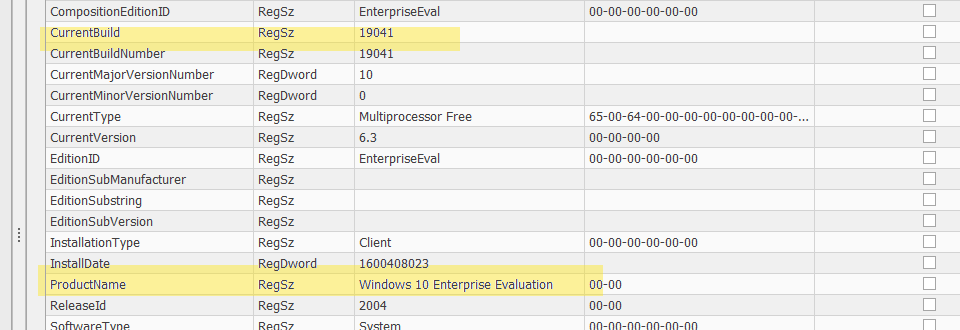
Fig 05: Operating system baseline
Windows 10 Enterprise Evaluation, version/build 19041, appears in the offline SOFTWARE hive.
Figure 5
Registry Explorer, SOFTWARE hive: Windows 10 Enterprise Evaluation, build 19041
| Fig 05 | Detail |
|---|---|
| Source tool | Registry Explorer |
| Artifact / investigation path | C:\Windows\System32\config\SOFTWARE → Microsoft\Windows NT\CurrentVersion |
| Forensic significance | Confirms the operating-system context for artifact and service interpretation. |
Fig 06: Forensic host identity
The offline registry records host DESKTOP-SDN1RPT. The Security log identifies DESKTOP-SDN1RPT.C137.local.
Figure 6
SYSTEM hive ComputerName: DESKTOP-SDN1RPT

| Fig 06 | Detail |
|---|---|
| Source tool | Registry Explorer |
| Artifact / investigation path | C:\Windows\System32\config\SYSTEM → ControlSet001\Control\ComputerName\ComputerName |
| Forensic significance | Scopes the findings to the acquired Windows workstation. |
Fig 07: Registry timezone context
TimeZoneKeyName is Pacific Standard Time and the recorded ActiveTimeBias is 420 minutes (UTC−07:00 for the displayed setting).
Figure 7
SYSTEM hive TimeZoneInformation: Pacific Standard Time, ActiveTimeBias 420

| Fig 07 | Detail |
|---|---|
| Source tool | Registry Explorer v2026.10.2 |
| Artifact / investigation path | SYSTEM → ControlSet001\Control\TimeZoneInformation |
| Forensic significance | Allows the analyst to avoid mixing host-local time with the UTC-normalized event and parser timeline. |
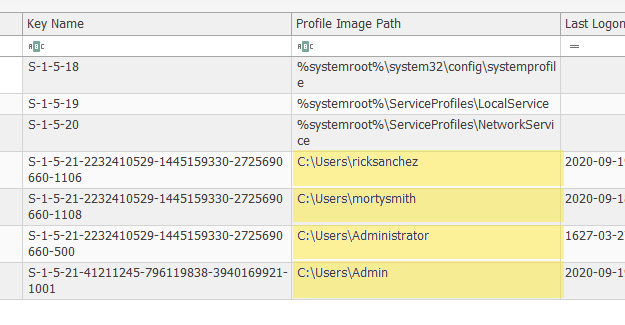
Fig 08: Local profile enumeration
Profile artifacts include Administrator, Admin, Rick, and Morty identities.
Figure 8
ProfileList: ricksanchez, mortysmith, Administrator and Admin profiles
| Fig 08 | Detail |
|---|---|
| Source tool | Registry Explorer |
| Artifact / investigation path | HKLM\SOFTWARE\Microsoft\Windows NT\CurrentVersion\ProfileList |
| Forensic significance | Preserves account context; mere profile presence is not evidence of compromise. |
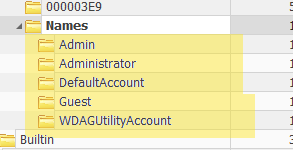
Fig 09: Local SAM account names
The local SAM Names key lists Admin, Administrator, DefaultAccount, Guest and WDAGUtilityAccount.
Figure 9
SAM Names key: Admin, Administrator, DefaultAccount, Guest, WDAGUtilityAccount
| Fig 09 | Detail |
|---|---|
| Source tool | Registry Explorer v2026.10.2 |
| Artifact / investigation path | SAM → SAM\Domains\Account\Users\Names |
| Forensic significance | Separates local account inventory from the separately observed C137\Administrator domain-account logon. |
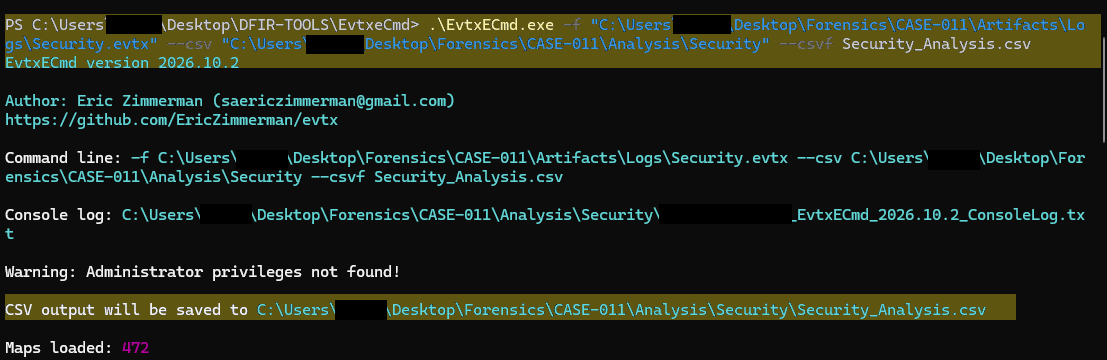
Fig 10: Recorded Security EVTX extraction command
The visible console shows EvtxECmd reading an extracted Security.evtx and saving the CSV at the analyst case path.
Figure 10
EvtxECmd parsing Security.evtx to Security_Analysis.csv (user name and console-log timestamp redacted)
| Fig 10 | Detail |
|---|---|
| Source tool | Windows PowerShell / EvtxECmd v2026.10.2 |
| Artifact / investigation path | C:\Users\[redacted]\Desktop\Forensics\CASE-011\Artifacts\Logs\Security.evtx → C:\Users\[redacted]\Desktop\Forensics\CASE-011\Analysis\Security\Security_Analysis.csv |
| Forensic significance | Gives an actual observed parser command and source/output paths rather than a reconstructed command example. |
| Interpretation control | The console also displays a privilege warning; it does not alone establish a parsing failure. |
Fig 11: Privileged Remote Desktop logon
2020-09-19 03:36:24 UTC: C137\Administrator successfully logged on using LogonType 10 (RDP). Source address 10.42.85.10; LogonId 0x857E73.
Figure 11
Event 4624, record 2125: C137\Administrator, LogonType 10 from 10.42.85.10 at 2020-09-19 03:36:24 UTC
| Fig 11 | Detail |
|---|---|
| Source tool | Timeline Explorer / EvtxECmd |
| Artifact / investigation path | C:\Windows\System32\winevt\Logs\Security.evtx → Security_Analysis.csv; Event ID 4624, Record 2125 |
| Forensic significance | Establishes a privileged remote interactive session preceding malware installation, not who owned the credentials. |
| Interpretation control | The source address is a private IP; it is not independently identified as an external attacker. |
Fig 12: Privileged account enumeration
2020-09-19 03:39:58 UTC: group/account enumeration associated with the Administrator session (LogonId 0x857E73), calling process PickerHost.exe.
Figure 12
Event 4798, record 2304: group membership enumerated in the same logon session, caller PickerHost.exe
| Fig 12 | Detail |
|---|---|
| Source tool | Timeline Explorer / EvtxECmd |
| Artifact / investigation path | Security.evtx → Security_Analysis.csv; Event ID 4798, Record 2304 |
| Forensic significance | Adds a behavioral pivot during the authenticated session, but the benign/malicious intent of this event is unproven. |
Fig 13: Executable placed in System32
File name coreupdater.exe, 7,168 bytes, MFT Created 2020-09-19 03:40:00 UTC; the entry remained allocated.
Figure 13
MFTECmd: coreupdater.exe in System32, 7,168 bytes, created 2020-09-19 03:40:00 UTC
| Fig 13 | Detail |
|---|---|
| Source tool | Timeline Explorer / MFTECmd |
| Artifact / investigation path | C:\$MFT → C:\Windows\System32\coreupdater.exe (MFT 26213) |
| Forensic significance | Places the suspicious executable on disk before execution and service registration. |
Fig 14: First observed execution by Prefetch
RunCount=1 and LastRun=2020-09-19 03:40:49 UTC for COREUPDATER.EXE.
Figure 14
PECmd: COREUPDATER.EXE run count 1, last run 03:40:49 UTC (user name and Source Accessed time redacted)
| Fig 14 | Detail |
|---|---|
| Source tool | Timeline Explorer / PECmd |
| Artifact / investigation path | C:\Windows\Prefetch\COREUPDATER.EXE-157C54BB.pf → [run time]_PECmd_Output.csv |
| Forensic significance | Provides affirmative execution evidence; it does not specify execution command line or parent process. |
Fig 15: Prefetch creation in $MFT
The Prefetch file is recorded at 2020-09-19 03:40:59 UTC and has an on-disk size of 5,343 bytes.
Figure 15
MFTECmd: COREUPDATER.EXE-157C54BB.pf created 2020-09-19 03:40:59 UTC, 5,343 bytes
| Fig 15 | Detail |
|---|---|
| Source tool | Timeline Explorer / MFTECmd |
| Artifact / investigation path | C:\$MFT → C:\Windows\Prefetch\COREUPDATER.EXE-157C54BB.pf (MFT 83852) |
| Forensic significance | Cross-validates the independent PECmd Prefetch parser result. |
Fig 16: Service persistence in SYSTEM hive
An Automatic Win32OwnProcess service points to C:\Windows\System32\coreupdater.exe. LastWrite: 03:42:42 UTC.
Source detail 1 of 2:
Figure 16a
Services\coreupdater: Automatic, Win32OwnProcess, last write 2020-09-19 03:42:42

Source detail 2 of 2:
Figure 16b
Services\coreupdater image path: C:\Windows\System32\coreupdater.exe

| Fig 16 | Detail |
|---|---|
| Source tool | Registry Explorer |
| Artifact / investigation path | C:\Windows\System32\config\SYSTEM → ControlSet001\Services\coreupdater |
| Forensic significance | Confirms Windows service persistence configuration. |
Fig 17: Service installation event
2020-09-19 03:42:42 UTC: Service Control Manager records installation of ‘coreupdater’, Automatic start, LocalSystem service account.
Figure 17
System Event 7045, record 958: service coreupdater installed, auto start, LocalSystem (user name in path redacted)
| Fig 17 | Detail |
|---|---|
| Source tool | Timeline Explorer / EvtxECmd |
| Artifact / investigation path | C:\Windows\System32\winevt\Logs\System.evtx → Event ID 7045, Record 958 |
| Forensic significance | Independent Windows event corroborates service-based persistence. |
Fig 18: Service creation CSV cross-check
The parsed record places coreupdater service installation at 03:42:42 UTC, Auto start, LocalSystem, image C:\Windows\System32\coreupdater.exe.
Source detail 1 of 2:
Figure 18a
Parsed 7045 row, part 1: 03:42:42 UTC, DESKTOP-SDN1RPT, Administrator SID, Name: coreupdater

Source detail 2 of 2:
Figure 18b
Parsed 7045 row, part 2: auto start, LocalSystem, C:\Windows\System32\coreupdater.exe

| Fig 18 | Detail |
|---|---|
| Source tool | Timeline Explorer / EvtxECmd |
| Artifact / investigation path | C:\Windows\System32\winevt\Logs\System.evtx → parsed service-installation record |
| Forensic significance | Makes the precise service fields legible and independently ties them to the Event 7045 detail in Fig 17. |
Fig 19: Malware reputation finding
64 of 71 antivirus engines reported the submitted sample/hash as malicious at the time captured.
Figure 19
VirusTotal: 64 of 71 vendors flag coreupdater.exe as malicious

| Fig 19 | Detail |
|---|---|
| Source tool | VirusTotal (external reputation service) |
| Artifact / investigation path | VirusTotal SHA-256 10f3b92002bb98467334161cf85d0b1730851f9256f83c27db125e9a0c1cfda6 |
| Forensic significance | Strong external malware corroboration, but no substitute for host-specific behavior records. |
Fig 20: Sample identifiers and size
MD5 eed41b4500e473f97c50c7385ef5e374; SHA1 fd153c66386ca93ec9993d66a84d6f0d129a3a5c; SHA256 10f3b9…cfda6; size 7,168 bytes.
Figure 20
VirusTotal basic properties: MD5, SHA-1, SHA-256 and file size 7,168 bytes
| Fig 20 | Detail |
|---|---|
| Source tool | VirusTotal / AmcacheParser |
| Artifact / investigation path | C:\Windows\AppCompat\Programs\Amcache.hve → Amcache_UnassociatedFileEntries.csv; VirusTotal sample details |
| Forensic significance | The SHA1 matches the offline Amcache inventory for the same executable path. |
Fig 21: Isolated malware sandbox lead
Sandbox behavior displays network indicator 203.78.103.109. This observation was generated in third-party sandbox infrastructure.
Figure 21
VirusTotal sandbox IP traffic: 203.78.103.109, a hunting lead only
| Fig 21 | Detail |
|---|---|
| Source tool | VirusTotal sandbox analysis |
| Artifact / investigation path | VirusTotal behavior tab for the submitted coreupdater.exe sample |
| Forensic significance | Treat as a hunting lead only: host-to-address communication is NOT evidenced by the acquired workstation artifacts. |
| Interpretation control | No victim-host network log independently links coreupdater.exe to 203.78.103.109. |
Fig 22: WebCache ESE container mapping
Container_8 (table ID 51) maps to a History container within the Administrator profile.
Source detail 1 of 2:
Figure 22a
ESEDatabaseView Containers table: Container 8, MSHist012020091820200919

Source detail 2 of 2:
Figure 22b
Container 8 directory: Administrator\AppData\Local\Microsoft\Windows\History

| Fig 22 | Detail |
|---|---|
| Source tool | ESEDatabaseView (NirSoft) |
| Artifact / investigation path | C:\Users\Administrator\AppData\Local\Microsoft\Windows\WebCache\WebCacheV01.dat → Containers table |
| Forensic significance | Provides provenance for the subsequent local-file History entries. |
Fig 23: History references to private documents
History entries refer to file:///C:/Users/mortysmith/Documents/My Social Security Number.txt, Plans.txt, Portal_gun.png, loot.zip, and Thoughts.txt.
Figure 23
Container_8 history: file:/// references to mortysmith documents, including loot.zip
| Fig 23 | Detail |
|---|---|
| Source tool | ESEDatabaseView (NirSoft) |
| Artifact / investigation path | WebCacheV01.dat → Container_8 / URL column → WebCache_Container8.txt |
| Forensic significance | Shows access/history references within the Administrator WebCache; does not establish how the files were copied or transmitted. |
Fig 24: Recent Items corroborate file activity
Recent shortcuts include loot.lnk, My Social Security Number.lnk, Plans.lnk, Portal_gun.lnk and Thoughts.lnk around 03:45–03:47 UTC.
Figure 24
Administrator Recent folder: loot.lnk, My Social Security Number.lnk, Plans.lnk, Portal_gun.lnk, Thoughts.lnk
| Fig 24 | Detail |
|---|---|
| Source tool | FTK Imager 4.5.0.3 |
| Artifact / investigation path | C:\Users\Administrator\AppData\Roaming\Microsoft\Windows\Recent\*.lnk |
| Forensic significance | Corroborates evidence of interaction with the named files in the Administrator context. |
Fig 25: loot.lnk identifies the archive path
The UTF-16 target path in the shortcut resolves to C:\Users\mortysmith\Documents\loot.zip. Link metadata reports an archive target of 131,041 bytes.
Figure 25
loot.lnk bytes in FTK Imager: target C:\Users\mortysmith\Documents\loot.zip
| Fig 25 | Detail |
|---|---|
| Source tool | FTK Imager / Shell Link byte inspection |
| Artifact / investigation path | C:\Users\Administrator\AppData\Roaming\Microsoft\Windows\Recent\loot.lnk |
| Forensic significance | Strong evidence the archive path existed/referenced at shortcut creation; its original contents were not recovered. |
| Interpretation control | Shortcut metadata is not a copy of loot.zip and is not proof of outbound transfer. |
Fig 26: SRUM database located
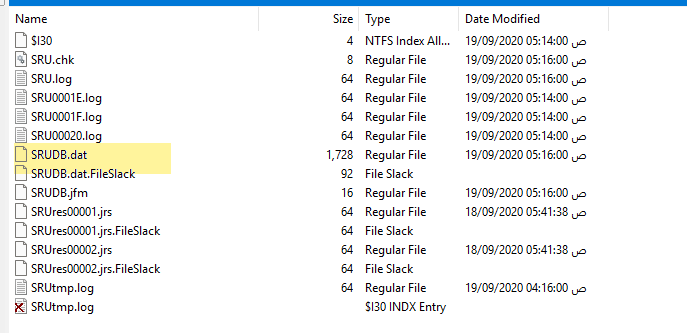
The live-system SRUM ESE database and related logs were located in the image.
Figure 26
FTK Imager: SRUDB.dat in C:\Windows\System32\sru
| Fig 26 | Detail |
|---|---|
| Source tool | FTK Imager 4.5.0.3 |
| Artifact / investigation path | C:\Windows\System32\sru\SRUDB.dat |
| Forensic significance | Documents the source artifact parsed by SrumECmd. |
Fig 27: Network usage attributed to coreupdater (I)
04:14 UTC bucket: coreupdater.exe, Administrator SID, 222,046 bytes sent; 333,817 bytes received.
Figure 27
SrumECmd record 190: coreupdater.exe, 04:14 UTC bucket, 222,046 bytes sent, 333,817 received
| Fig 27 | Detail |
|---|---|
| Source tool | SrumECmd / Timeline Explorer |
| Artifact / investigation path | C:\Windows\System32\sru\SRUDB.dat + SOFTWARE → SrumECmd_NetworkUsages_Output.csv, Id 190 |
| Forensic significance | Confirms application-attributed interface activity, not destination, protocol, remote transfer or exact connection moment. |
Fig 28: Network usage attributed to coreupdater (II)
05:14 UTC bucket: coreupdater.exe, Administrator SID, 26,570 bytes sent; 170,146 bytes received.
Figure 28
SrumECmd record 193: coreupdater.exe, 05:14 UTC bucket, 26,570 bytes sent, 170,146 received
| Fig 28 | Detail |
|---|---|
| Source tool | SrumECmd / Timeline Explorer |
| Artifact / investigation path | C:\Windows\System32\sru\SRUDB.dat + SOFTWARE → SrumECmd_NetworkUsages_Output.csv, Id 193 |
| Forensic significance | The two recorded buckets total 248,616 sent bytes and 503,963 received bytes, but do not by themselves prove exfiltration. |
Fig 29: Recycle Bin review
The user SID folders visible during triage did not contain recoverable loot.zip entries.
Figure 29
$Recycle.Bin SID folders, with no loot.zip entry
| Fig 29 | Detail |
|---|---|
| Source tool | FTK Imager 4.5.0.3 |
| Artifact / investigation path | C:\$Recycle.Bin\S-1-5-21-* |
| Forensic significance | Negative recovery result for this inspected artifact; absence does not establish secure deletion. |
Fig 30: Firewall text-log availability
The firewall LogFiles\Firewall directory appears empty in the acquired image.
Figure 30
LogFiles\Firewall directory, empty: no pfirewall.log
| Fig 30 | Detail |
|---|---|
| Source tool | FTK Imager 4.5.0.3 |
| Artifact / investigation path | C:\Windows\System32\LogFiles\Firewall\pfirewall.log |
| Forensic significance | A network destination cannot be recovered from a text log that is not present. |
Fig 31: USN journal stream limitation
The FTK properties pane reports Alternate Data Stream Count=2 while the unnamed file stream has size 0. The $J stream was not recovered in this workflow.
Figure 31
$UsnJrnl properties: size 0, Alternate Data Stream Count 2; $J not recovered
| Fig 31 | Detail |
|---|---|
| Source tool | FTK Imager 4.5.0.3 |
| Artifact / investigation path | C:\$Extend\$UsnJrnl; desired $DATA stream: C:\$Extend\$UsnJrnl:$J |
| Forensic significance | No $UsnJrnl analysis was available to confirm deletion/rename operations for loot.zip. |
13. Reproducibility appendix: export names
| Supplied export or artifact | Role / source |
|---|---|
| MFT_Analysis.csv | MFTECmd output for offline NTFS $MFT; 132,615 lines in analyst view. |
| CASE-011\Artifacts inventory | File Explorer capture documents $MFT.copy0, $LogFile.copy0, $UsnJrnl.copy0, SAM/SOFTWARE/SYSTEM, Amcache.hve and source artifact folders (Fig 03). |
| CASE-011\Analysis inventory | File Explorer capture documents Amcache, MFT, Prefetch, Security, Shimcache, SRUM, System and WebCache analysis subfolders (Fig 04). |
| Security_Analysis.csv | EvtxECmd output from Security.evtx; 2,457 event rows in analyst view. |
[run time]_PECmd_Output.csv |
Prefetch parsing output used for one recorded run. |
[run time]_Amcache_UnassociatedFileEntries.csv |
Amcache file inventory; same SHA1 as sample. |
[run time]_Windows10C_11_SYSTEM_AppCompatCache.csv |
Compatibility cache review, no coreupdater hit in supplied export. |
[run time]_SrumECmd_NetworkUsages_Output.csv |
Two process-attributed SRUM network usage records. |
| WebCacheV01.dat; V01*.log; V01.chk | Extracted ESE database and transactional companion logs. |
| WebCache_Container8.txt | ESEDatabaseView table export of Administrator history. |
| loot.lnk; Plans.lnk; Portal_gun.lnk; Thoughts.lnk; My Social Security Number.lnk | Extracted shortcut evidence, not contents of referenced target files. |
| Analyst screenshot series | Analyst UI record; the tool and artifact path of each are given in its plate. |
| DESKTOP-E01.zip — SHA256/MD5 local hashes | Calculated in PowerShell; fingerprints of ZIP package only, no comparison to original forensic acquisition manifest. |
Interpretation and preservation notes
- Do not conflate historical target timestamps (2020) with case-analysis/export timestamps.
- Do not conflate VirusTotal sandbox behavior with endpoint-observed network destinations.
- Do not conflate target filename/size recorded in .lnk with independently recovered ZIP content.
- Do not infer an unobservable transfer from SRUM aggregate bytes or from missing local logs.
- Do not treat locally recorded hashes of DESKTOP-E01.zip as a verified original acquisition digest for 20200918_0417_DESKTOP-SDN1RPT.E01.
- Protect the user’s private documents and identifiers during broader distribution; this report omits actual sensitive values.